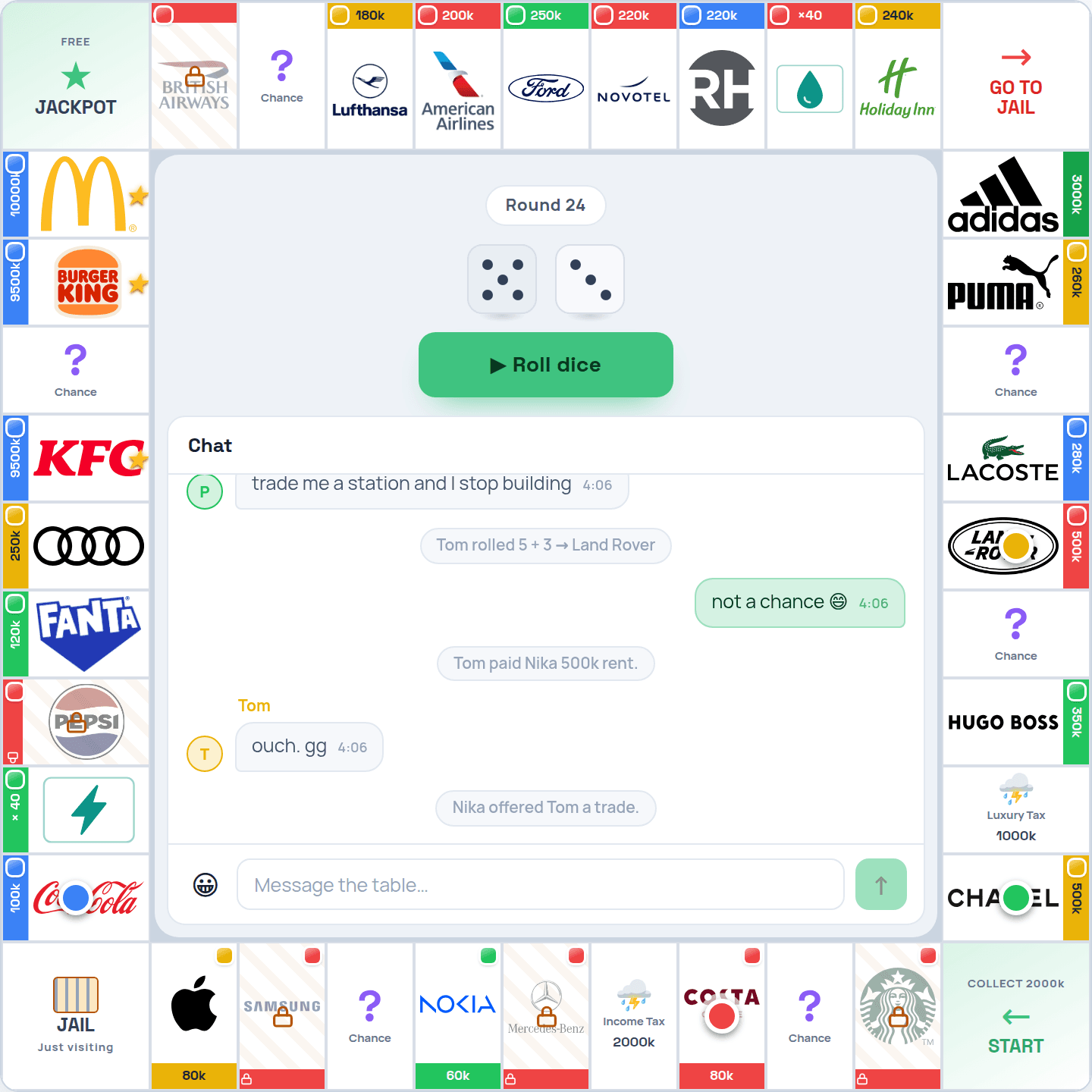
Monopoly-Style Game Statistics: 3,900 Simulated Games
We ran 3,900 complete games through the opolyx rules engine and counted every roll, landing and rent payment — 1,976,237 dice rolls in total. The headline result: the Fast Food group collects 14.33% of all rent paid, more than any other, and the most landed-on square is Start at 3.3% of all moves.
These are not estimates from a rulebook. Every figure below comes from replaying the real game — the same engine that runs live matches on opolyx — so it describes how the board actually behaves rather than how it should behave in theory.
How the numbers were produced
3,900 games across all 3 modes and every player count from 2 to 6, each one played to a natural finish by the strategy bots (no game hit a step limit). Every run is seeded, so the sweep reproduces exactly on any machine. That gives 1,976,237 dice rolls and 2,058,855 token moves to count.
Which colour group earns the most rent
Share of all rent paid across every game, by colour group. This is the number that decides which properties are worth fighting for.
| Group | Share |
|---|---|
| Fast Food | 14.33% |
| Hotels | 12.86% |
| Drinks | 12.51% |
| Apparel | 12.02% |
| Airlines | 11.54% |
| Luxury | 10.37% |
| Cars | 9.86% |
| Tech | 8.55% |
| Utilities | 4% |
| Coffee | 3.94% |
The Fast Food group leading at 14.33% is a real result, not a quirk of our board: the squares just past jail get hit disproportionately often because everyone leaving jail rolls into them. The cheapest groups sit at the bottom for the opposite reason — low rent, and too close to Start to catch traffic.
The most landed-on squares
Share of all 2,058,855 token moves that ended on each square. The top 10:
| # | Square | Share |
|---|---|---|
| 1 | Start | 3.3% |
| 2 | Coca-Cola | 3.05% |
| 3 | Burger King | 2.99% |
| 4 | McDonald's | 2.97% |
| 5 | Water Works | 2.95% |
| 6 | Jackpot | 2.91% |
| 7 | Electric Company | 2.88% |
| 8 | Ford | 2.83% |
| 9 | British Airways | 2.78% |
| 10 | KFC | 2.76% |
Dice, jail and bankruptcy
- 16.64% of rolls are doubles — against a theoretical 16.67% for two fair dice, which is the cheapest proof the simulation is sound.
- A game sees 18.4 trips to jail. 67.49% of them come from the Go-to-jail square, 23.88% from a Chance card and 8.63% from rolling three doubles in a row.
- 2.5 players go bankrupt per game on average — so most games are decided by someone running out of money, not by the round cap.
- Every square gets landed on: the gap between the most and least visited is roughly a factor of two, not ten.
How long a game lasts
Median rounds to a finish, by mode:
| Mode | Rounds (median) |
|---|---|
| Classic | 70 |
| Speed | 73 |
| Team | 87 |
| All modes | 74 |
Questions about the data
Which properties are the best in a Monopoly-style game?
By rent collected, the Fast Food group is the strongest at 14.33% of all rent paid, followed closely by the next two mid-board groups. The squares shortly after jail earn most because every player leaving jail rolls straight into them.
What is the most landed-on square?
Start, on 3.3% of all moves. Landing frequency is flatter than most people expect — the whole board sits within roughly a two-to-one band, so no single square dominates.
How long does a game take?
The median game runs 74 rounds. Speed mode finishes in 73 and Classic in 70; Team games run longest at 87, because a bankrupt player’s estate passes to a teammate instead of leaving the table.
Do these numbers apply to the original board game?
Partly. The dice, the jail mechanics and the shape of the board are the same, so the landing distribution and the doubles rate carry over. The prices, rents and some squares are specific to opolyx, so treat the rent shares as a guide to this game rather than an exact figure for any other.