Monopoly Rules Online — How to Play, Win, and Finish Faster
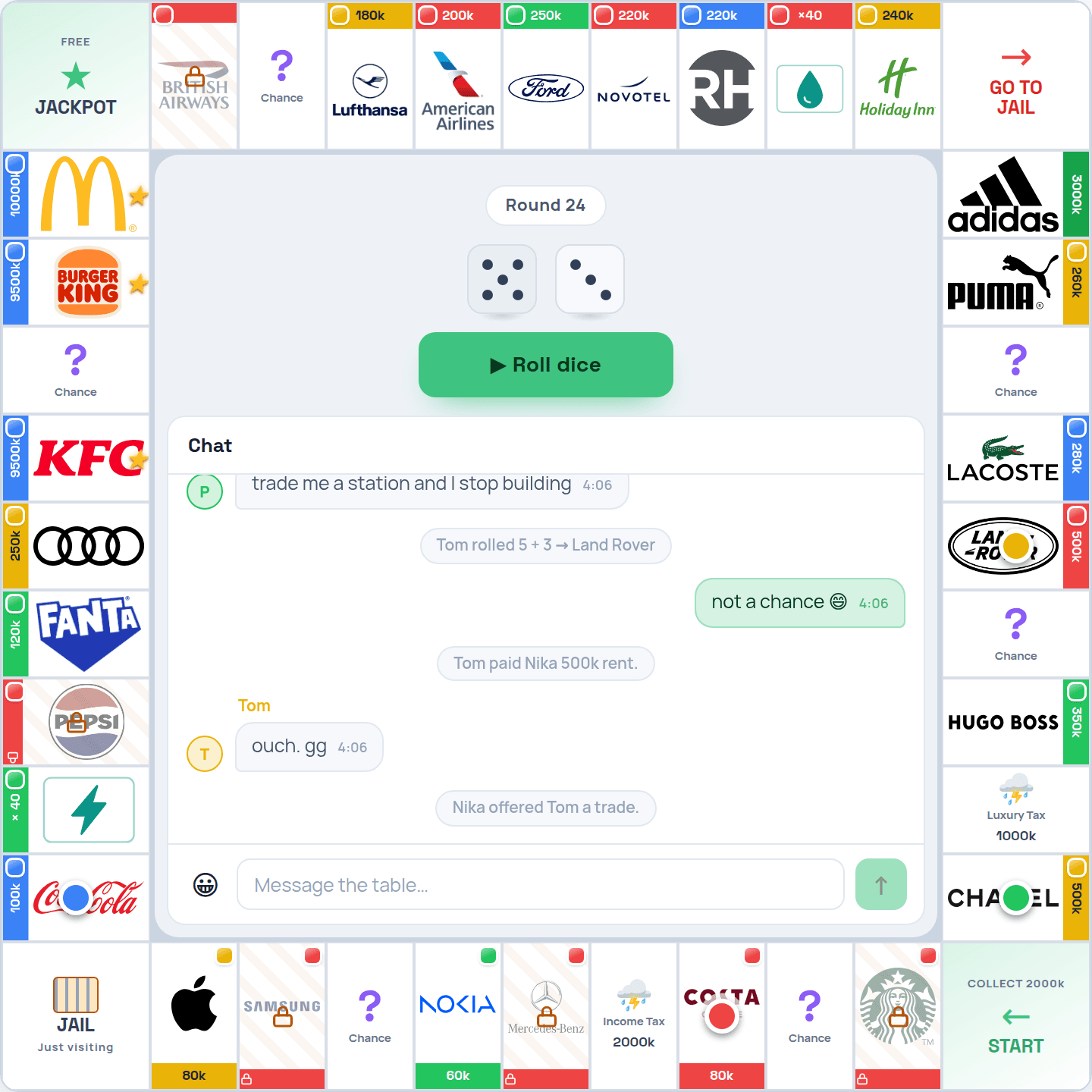
Monopoly-style play is simple: roll two dice, move, then buy the property you land on or pay rent if it is owned. Collect salary at Start, build on full colour sets, and trade to win. Read the full rulebook on opolyx, or just start a game and learn as you go.
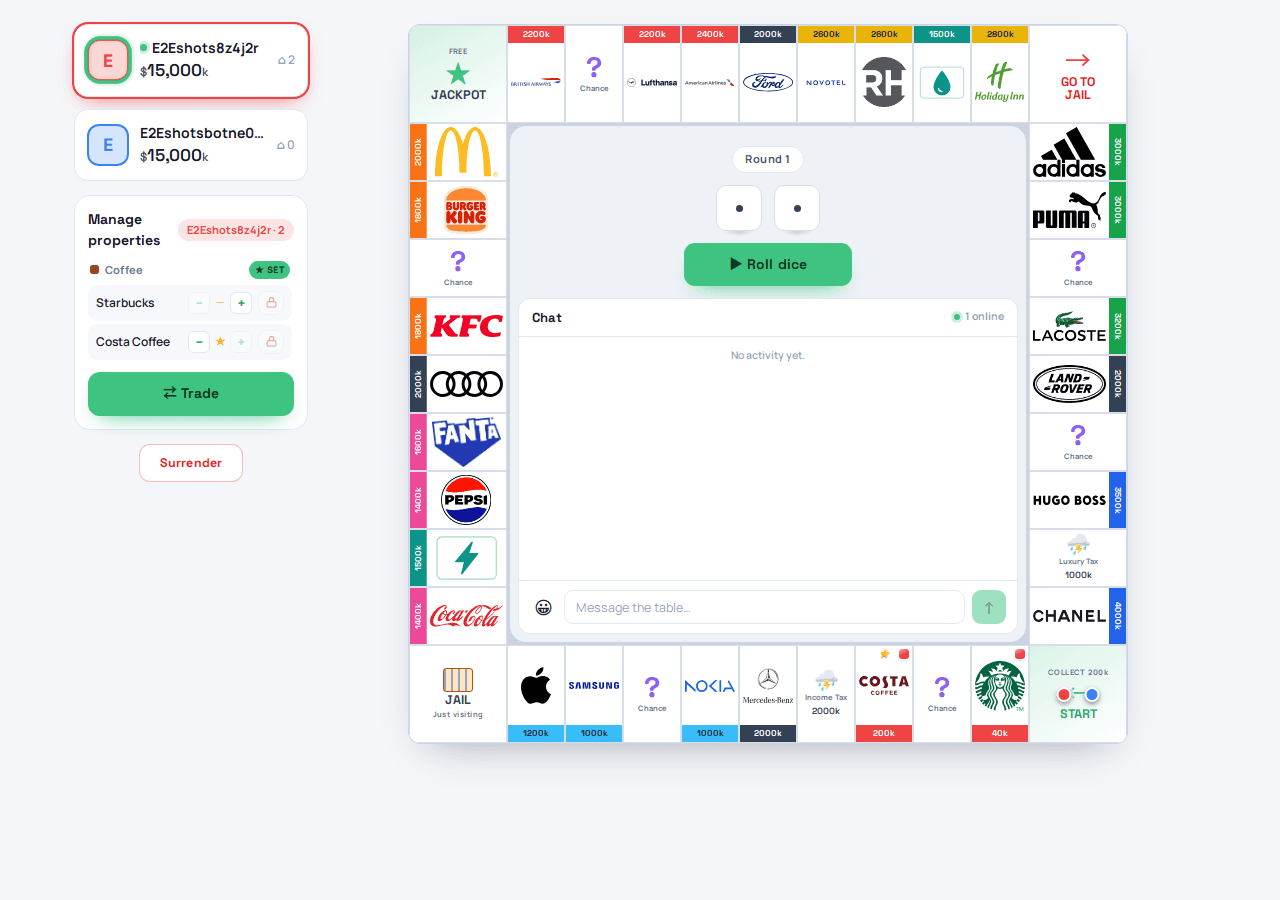
opolyx is a free, online Monopoly-style board game you play in the browser. This page is a quick, plain-English explainer of the classic rules opolyx uses — enough to sit down and play right away. When you want the fine print, the complete rulebook and a turn-by-turn walkthrough are one click away.
How do you play Monopoly?
A turn is a short, repeatable loop. On opolyx most of it is automatic — you just make the decisions — but the underlying rules are the ones you already know.
- 1Roll the dice and move
Roll the two dice and move your token that many squares around the board, clockwise from where you are.
- 2Buy it or send it to auction
Land on an unowned property and you may buy it at its list price. Decline, and it goes to auction for every player to bid on.
- 3Pay rent if it is owned
Land on a property someone else owns and you pay them rent. Rent is higher on full colour sets and rises with each house you build.
- 4Collect salary at Start
Every time you pass or land on Start you collect your salary, which keeps cash flowing into the game.
- 5Build, mortgage, and trade
Own a full colour set to build houses for higher rent. Mortgage properties to raise cash in a pinch, and trade with rivals to complete sets.
- 6Doubles roll again
Roll doubles and you take another turn — but roll three doubles in a row and you go straight to jail.
How do you win at Monopoly?
You win by being the last player standing once everyone else goes bankrupt — or, if the round cap arrives first (Blitz has a short one), by the highest net worth. That outcome almost always comes down to a few practical habits rather than luck:
- Complete colour sets. A single street earns little; a full set lets you build, and houses are where the big rent comes from.
- Trade to finish sets. The fastest route to a monopoly is usually a deal, not the dice — offer cash or a spare property to get the square you need.
- Keep a cash cushion. Building is good, but going broke when you land on a rival’s hotel ends your game. Leave enough to survive the next few rents.
- Mortgage deliberately. Raising cash on a quiet property to build on a busy one can be the right call; just remember the unmortgage cost later.
- In Speed, use the third die. The Speed die can carry you onto the property you want or hand you a free move — plan around it.
How does the auction rule work?
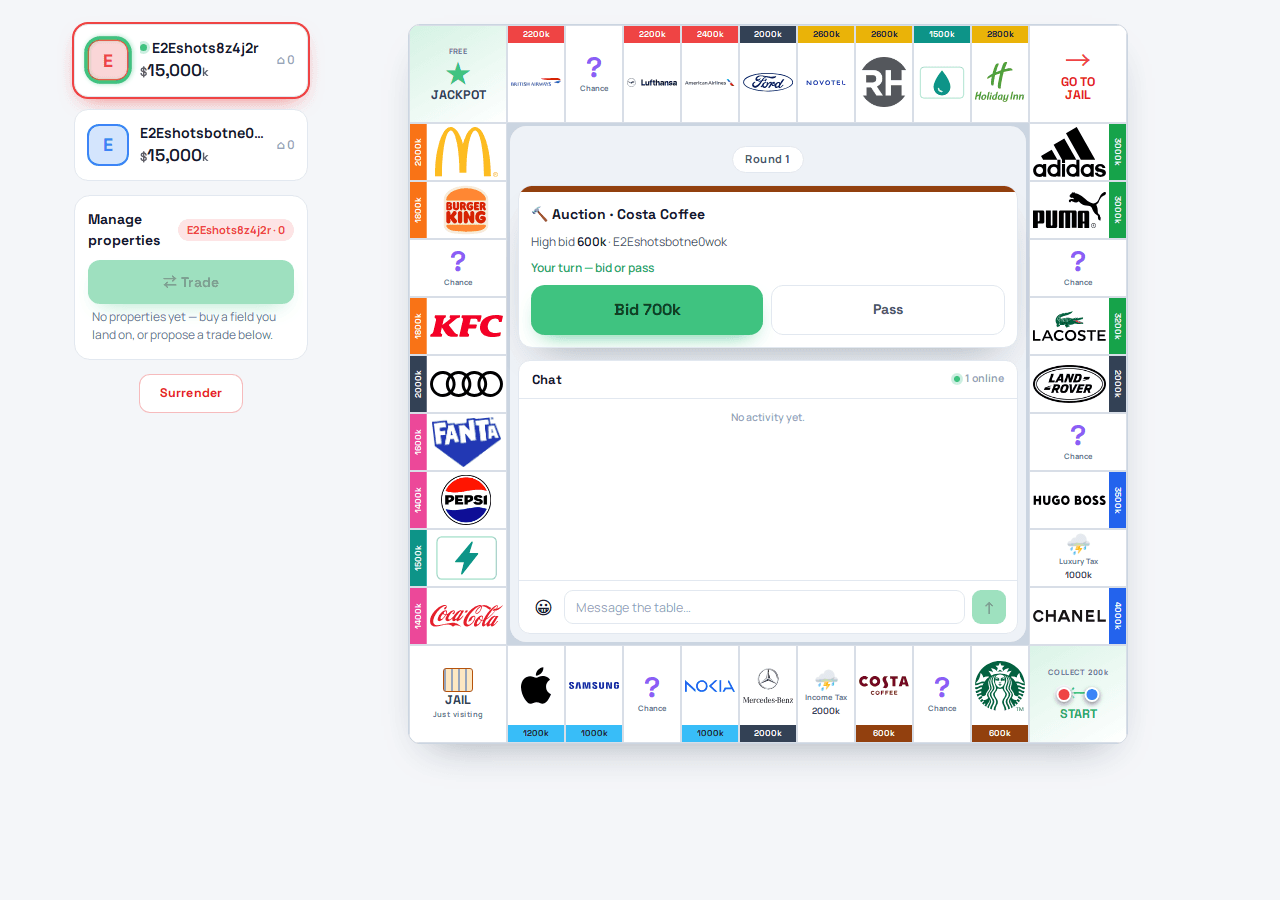
The auction is the most-skipped real rule in tabletop Monopoly, and it changes the game. When a player lands on an unowned property and chooses not to buy it, the property does not stay on the shelf — it is auctioned to all players. On opolyx the auction is turn-based: each player gets a short window (about ten seconds) to raise the bid or pass, and the highest bidder wins it, at the list price or above.
What is rent, and how is it worked out?
Rent is what you pay when you land on a square somebody else owns, and it is the whole engine of the game — property earns nothing until an opponent lands on it. A street's rent comes from its own table and rises with every house on it. Owning the complete colour group doubles the base rent on every square in it even before you build, which is why completing a set matters more than owning many scattered squares. Stations pay more the more of them one player holds; utilities charge a multiple of the dice you just rolled. A mortgaged square collects nothing at all, and you never pay rent to yourself or to a teammate. See how players actually win for what to do with that.
How does mortgaging work?
Mortgaging is how you raise cash without selling a property outright. You hand the square to the bank as security and immediately receive half its printed price; buying it back later costs that same half plus ten per cent interest (in Halal, exactly the half, with no interest). While a square is mortgaged it collects no rent, so mortgaging your best colour group to pay a debt is usually how a losing position becomes a lost one. You cannot mortgage a square that still has buildings anywhere in its colour group — sell those first. Speed mode adds a deadline: a mortgaged square that is not bought back within a set number of rounds goes back to the bank for good, and the faster modes are built around exactly that pressure.
What are the jail rules?
You go to jail by landing on the Go to Jail square, drawing a card that sends you there, or rolling three doubles in a row. While in jail you still own everything and still collect rent. To get out you can roll doubles on your turn, pay the fine, or wait out three failed rolls — after which the fine is charged and you move with your last roll.
What are the Speed die rules?
Speed mode adds a third die — the Speed die — on top of the usual two, and it is what makes a game move fast. It can show a number, a Bus, or an X:
- A number face adds straight to your move, so you cover more ground each turn.
- A Bus face lets you choose your move instead of being stuck with the dice total.
- An X face sends you to the nearest property — handy for landing on the square you have been eyeing.
- A triple lets you teleport anywhere on the board and roll again.
How long does a game take, and how do you make it faster?
A classic Monopoly-style game can run long — once players are circling the board collecting rent, it can stretch for an hour or more. If you want a quicker game, opolyx gives you three reliable levers: pick Blitz (a fixed round limit) or Speed mode (the third die and faster turns), play with fewer players, and fill empty seats with bots so nobody is waiting on a slow human. Two rules also finish a game nobody is winning: Blitz stops at 25 rounds and hands the win to the biggest net worth, and in the other modes rent starts being taxed as the rounds pile up — from round 40 in Speed, much later in Classic — so cash drains out of the game until somebody breaks.
How many dice are in Monopoly?
Classic Monopoly-style play uses two dice — you roll both and move the combined total, and matching numbers (doubles) let you roll again. Speed mode adds a third die, the Speed die, for a total of three. The two standard dice still set your basic move; the Speed die layers its number, Bus, or X effect on top.
Common questions
How do you win at Monopoly?
Be the last player who is not bankrupt, or the richest when the round cap arrives. In practice that means completing colour sets, building houses for higher rent, trading to finish sets, and keeping enough cash to survive landing on rivals’ properties.
How long does a game of Monopoly take?
A classic game can run an hour or more. On opolyx you can shorten it a lot by using Blitz or Speed mode, playing with fewer players, and adding bots so turns move quickly.
How do you make Monopoly faster?
Use Blitz for a fixed round limit, or Speed mode for the third die, faster turns and a mortgage timer; reduce the number of players; and add bots to keep the pace up. Trading early to build sooner also brings a game to a head faster.
How many dice are in Monopoly?
Two dice in Classic. Speed mode adds a third — the Speed die — for three in total, where the Speed die adds a number, a Bus move-choice, or an X jump on top of your roll.
What is the Monopoly auction rule?
If a player lands on an unowned property and chooses not to buy it, the property is auctioned to all players. On opolyx the auction is turn-based with a short window per bidder, and the highest bid wins.
What are the jail rules?
You enter jail from the Go to Jail square, certain cards, or three doubles in a row. You still collect rent while inside, and you leave by rolling doubles or paying the fine — after three failed rolls the fine is charged automatically.
Are these the official Monopoly rules?
opolyx is a Monopoly-style game and is not affiliated with Hasbro or MONOPOLY. It follows the familiar classic rules described here; read the full rulebook for every detail.
Can I just learn by playing?
Yes. Most of the turn is automatic on opolyx, so you can start a game, follow the on-screen prompts, and pick up the rules as you go. The full rulebook is there when you want it.
What is rent in Monopoly?
Rent is the payment you owe when you land on a square another player owns. It rises with the buildings on that square, doubles on an unbuilt square when its owner holds the complete colour group, scales with how many stations one player owns, and is a multiple of your dice roll on a utility. A mortgaged square charges nothing.
How does a mortgage work?
You mortgage a square to the bank for half its printed price and can buy it back later for that half plus ten per cent interest (in Halal, for exactly that half). A mortgaged square collects no rent while it is mortgaged, and you must sell every building in its colour group before you can mortgage any square in that group.
What are the rules for a fast game?
Blitz uses the Classic rules with a round cap: when the cap is reached the game ends immediately and the player with the highest net worth wins, rather than play continuing until everyone else is bankrupt. Speed instead keeps the bankruptcy ending but adds a third die, an earlier rent tax, uneven building and a deadline on mortgages.
Does rent get smaller late in a Monopoly game?
On opolyx it does, on the owner’s side. Once a game runs long the rent is taxed: the tenant still pays in full, but a growing share leaves the game instead of reaching the owner, rising to 99%. It begins at round 40 in Speed and much later in Classic. Blitz ends at 25 rounds, before the tax ever starts.
Do the rules change between modes?
The core rules are the same in every mode but one. Blitz adds a round limit, Speed a third die and uneven building, Team two allied sides, Halal takes out interest and gambling, Fortune adds the Temple of Wealth and festive rules, Deal deals out every field before the first roll, and Russian Roulette drops the money altogether: a pistol on every square but the corners, and the last player in wins. The modes page compares them.
Want every detail, including rent tables and edge cases? Read the complete rulebook, or follow the turn-by-turn guide and then jump straight into a game.