Monopoly Glossary: Every Term in a Property-Trading Game
Every word you need to read a Monopoly-style board, defined in one line each. The first section covers the vocabulary any property-trading game shares; the second covers the mechanics specific to opolyx.
If you are mid-game and someone has just used a word you do not know, this is the page to check. Each entry is a single self-contained definition — no need to read the rest.
Board and property vocabulary
The terms shared by every game in the property-trading genre.
What is a monopoly (a set)?
Owning every square in one colour group. Only then can you start building, and rent on those squares roughly doubles even before you build anything.
What is a branch (house/hotel)?
A building you add to a street you fully own. Each one raises that square's rent sharply; the last level is the equivalent of a hotel.
What is rent?
What you pay the owner when your token stops on their property. It depends on the square, whether they own the whole group, and how much they have built.
What is a mortgage?
Raising cash by pledging a property to the bank for half its purchase price. A mortgaged square collects no rent until you buy it back at that price plus ten percent.
What is an auction?
When a player declines to buy the square they landed on, it goes to the table. In opolyx bidding is turn-based, starts at the list price and rises in fixed steps until everyone else passes.
What is bankruptcy?
Owing more than you can raise by mortgaging and selling everything. You liquidate what you can, pay the creditor, and leave the game.
What is a title deed?
The card describing a property: its price, its rent at every building level, its mortgage value and the cost per branch.
What are utilities?
Squares that charge a multiple of your dice roll instead of a fixed rent. Owning both raises the multiplier sharply.
What are stations (dealerships)?
Squares that cannot be built on. Rent depends purely on how many of the four the same player owns, doubling with each one.
opolyx mechanics
Terms that belong to this game specifically.
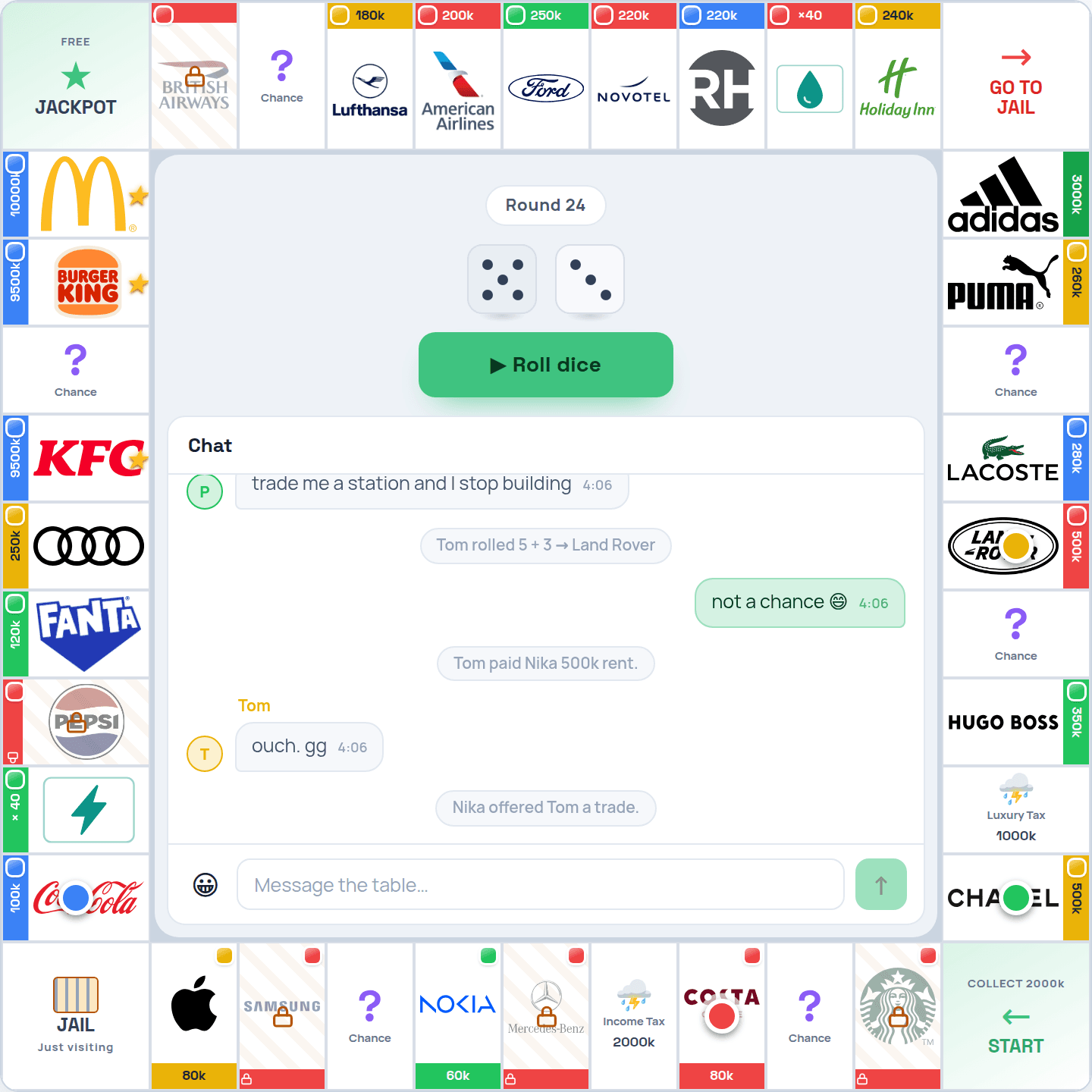
What is the Jackpot square?
A dice mini-game where you pick one to three numbers, pay a flat stake and roll. Hitting one pays out from the bank; it is priced to be even money in the long run.
What is the speed die?
A third die used in Speed mode from round seven. It can add to your move, trigger a bus jump, or send you to the nearest unowned or opponent property.
What is the rent tax?
A percentage taken off rent once a game runs long, to stop late games stalling. It applies to rent only, never to the salary you collect passing Start.
What is the payment pause?
When you owe money you cannot immediately cover, the game stops and gives you a Pay button plus the chance to sell branches and mortgage until you can settle — or declare bankruptcy if you truly cannot.
What is a card boost?
Owning a collectible card for a field raises the rent you charge on it, by five to thirty percent depending on rarity. Boosts do not stack and are capped.
What is XP?
Points every seat earns for finishing a game, scaled by where you placed, monopolies held and whether you survived. XP drives your level and rank.
What is a tier?
The rank band your level falls into, from Qualifier up to Master. It shows on your profile and beside your name on the leaderboard.
What is Team mode?
Two-versus-two or three-versus-three, where a team wins together and a bankrupt player's estate passes to their surviving teammate rather than back to the bank.
What is the turn timer?
A per-turn countdown. Let it run out and the game plays a safe default for you; go quiet repeatedly and you are surrendered so the table can continue.
Still not sure about a rule?
The full rulebook covers every case in order, and the complete guide walks through each mechanic with screenshots. Both are linked below.