Monopoly Strategy: How to Win, Backed by 3,900 Games
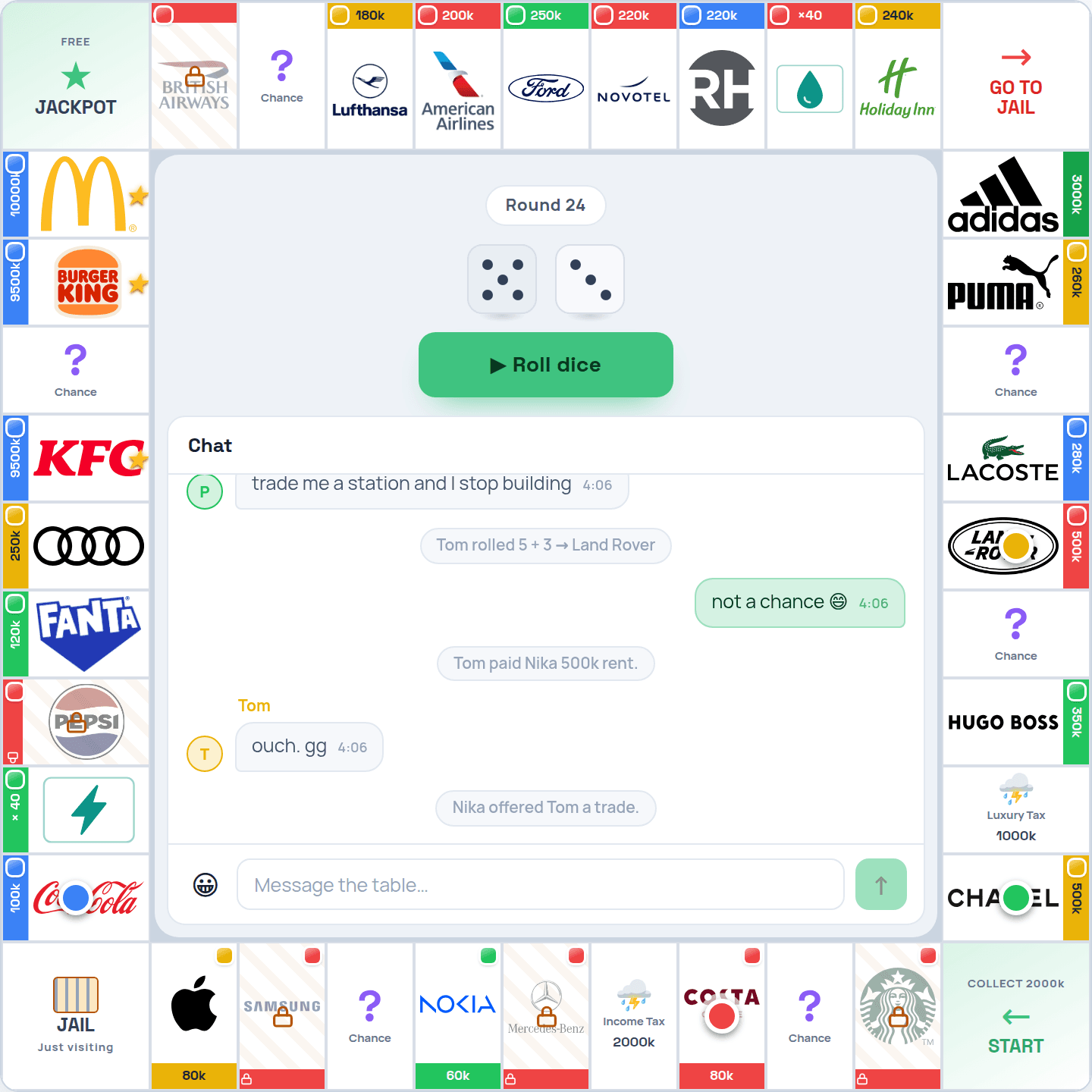
The short version: buy almost everything early, then trade hard for one complete colour group and build it out before anyone else finishes theirs. Our own data across 3,900 games backs the priority — the Fast Food group collects 14.33% of all rent paid, more than any other, and the cheapest group manages only 3.94%.
Most strategy advice for this genre is folklore. The advice below is checked against a simulation of 3,900 complete games run through the same engine that plays live matches, so where a claim is quantitative you can see the number behind it.
Buy early, almost indiscriminately
In the opening rounds cash is worth less than position. Every square you leave unbought is a square someone else can complete a set with — and an auction you have handed to a rival for free.
- Buy anything you land on in the first few laps unless it would leave you unable to pay a realistic rent.
- Declining a purchase does not keep the square safe: it goes to auction, where someone else will usually get it cheaper than list price.
- A scattered collection is still useful — it is trade material, and it blocks the sets other players need.
Which colour groups actually pay
Rent collected across 3,900 games, by group: Fast Food leads at 14.33%, then Hotels at 12.86% and Drinks. The bottom is the cheapest group at 3.94%. The mid-board groups win because of jail: every player who leaves jail rolls straight into the stretch just after it, so those squares take far more traffic than their price suggests.
Build as soon as you hold a set — and stop short of broke
An undeveloped monopoly earns almost nothing. The jump in rent from bare street to fully built is roughly two orders of magnitude, and it is what actually bankrupts people: 2.5 players go bankrupt in an average game.
- Get to the middle levels on a whole set rather than maxing out one street — rent scales fastest through the middle of the ladder.
- Keep enough cash to survive one bad landing on the biggest developed property in play. Building yourself broke loses games that a single turn of patience would have won.
- In Speed mode you can build unevenly, so pouring everything into one street is viable there in a way it is not in Classic.
Auctions are where games are quietly decided
An auction has no floor beyond the opening bid, so property routinely sells below list price. Bid on anything that completes or blocks a set even if you do not want it at that price — the alternative is a rival completing a monopoly cheaply. But hold a bound: winning an auction with money you needed for rent is the most common way to hand over a game.
Jail: a trap early, a shelter late
Players see jail 18.4 times in an average game. Early on it is bad — you are not buying and not moving while the board is being claimed. Late, when the board is developed and every lap is expensive, sitting in jail is often the best square available: you still collect rent, and you do not land on anyone. Pay the bail early, serve the time late.
Trading is the only way to finish a set
- Nobody completes a monopoly on dice alone in a normal game. If you are not proposing trades, you are not going to win.
- Trade away property in groups you cannot complete. A single square in someone else’s set is worth far more to them than to you, and cash plus a blocking square is a strong ask.
- Watch what a trade gives the other side: handing a rival their third square is usually worse than not trading at all, however good the cash looks.
Strategy questions
What is the best strategy in a Monopoly-style game?
Buy aggressively in the opening rounds, trade for one complete colour group as early as you can, and build it out to the middle levels while keeping a cash cushion. Prefer the mid-board groups: the Fast Food set alone takes 14.33% of all rent paid in our 3,900-game sample.
Which properties should I buy first?
Take the mid-board colour groups over the expensive end ones. They are cheaper to complete and to develop, and they sit in the stretch everyone leaving jail rolls into — which is why they out-earn the pricier sets in practice.
Is it better to stay in jail?
Late in the game, usually yes. Once the board is developed you keep collecting rent while risking nothing, and the average game already sees 18.4 jail visits. Early on it is the opposite: pay the bail and get back to buying.
How long should I expect a game to last?
A median game runs 74 rounds. If you want it shorter, Speed mode compresses the same strategy: build faster, mortgage sooner, and take the auctions you would normally pass on.