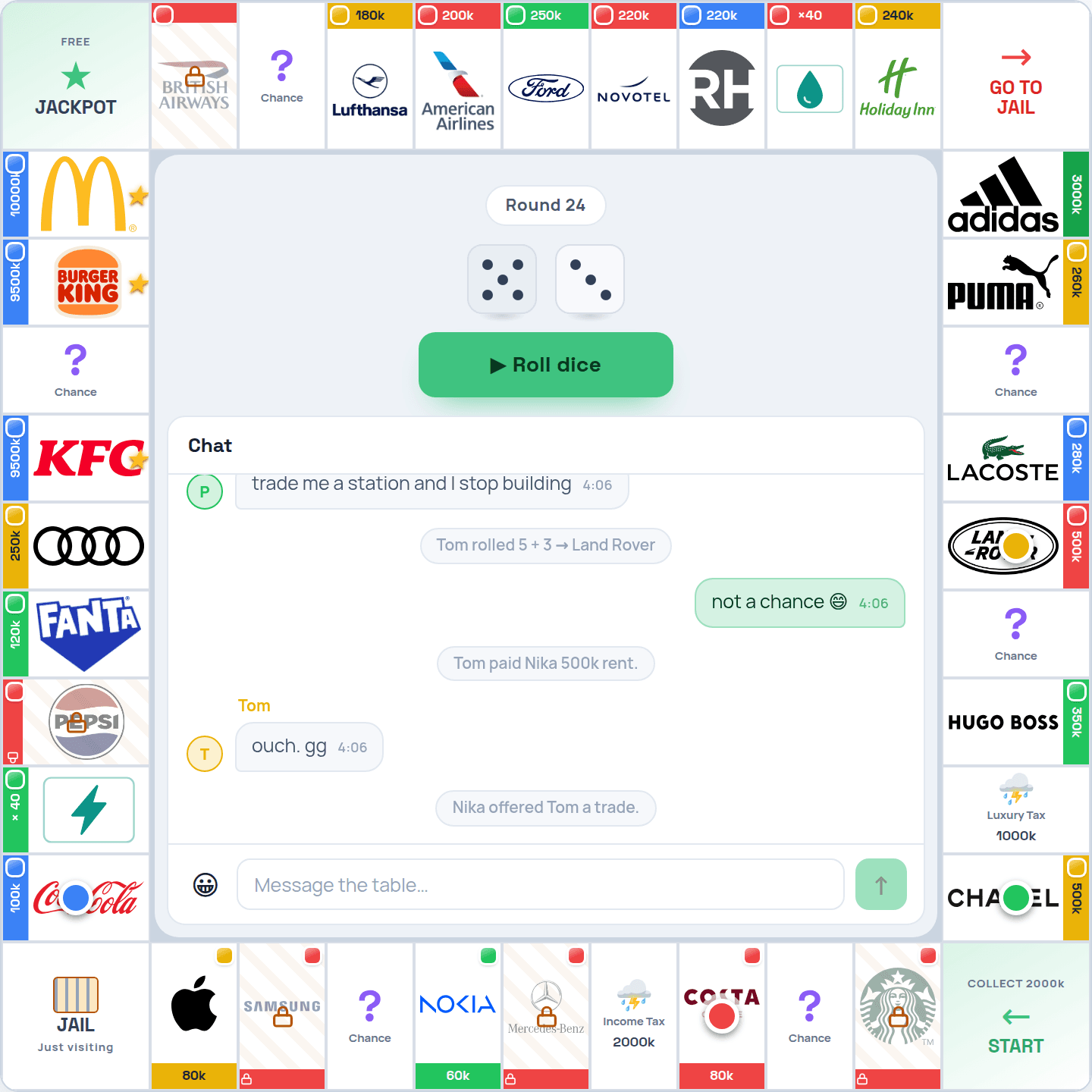
Setting up the board…
Shuffling cards and seating players
Setting up the board…
Shuffling cards and seating players
The complete rules of opolyx — the board, turns, rent, building, trading, jail, the Jackpot and how a game ends — across Blitz, Classic, Speed and Team.
Buy companies, charge rent on them, and squeeze everyone else out of cash. A game ends when only one solvent player is left, or when the round cap is reached — at which point the richest player by net worth wins. In Team mode both endings are decided by team rather than by player.
A table seats two to six players, in any mix of people and bots. You can be in one unfinished game at a time; once you are eliminated you are free to start or join another while the rest play on.
The mode is fixed when the room is created. The player who goes first is drawn at random, not the player who opened the room, and a round is complete only once every player has taken a turn — that is what the round cap and the rent tax count.
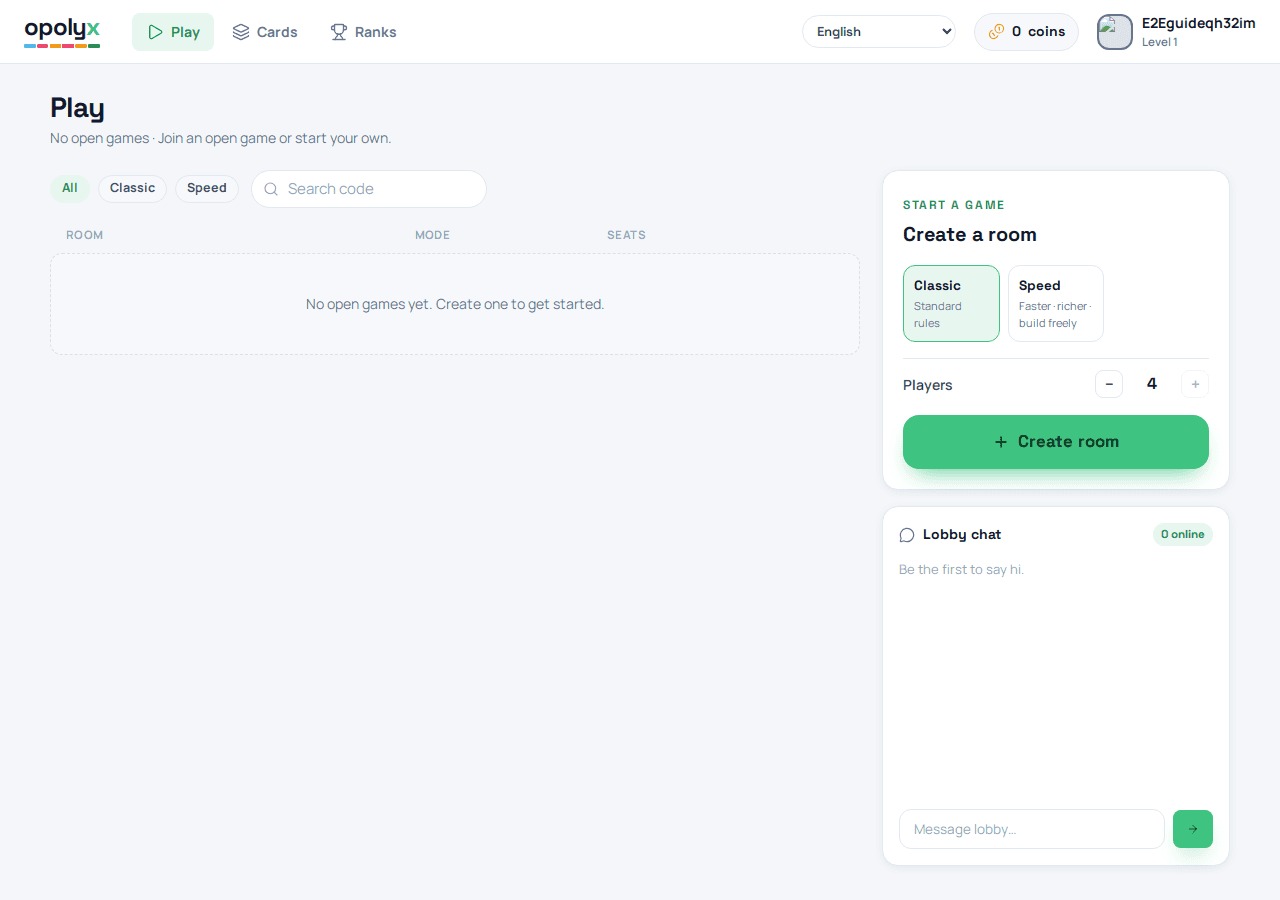
The board has 40 squares: 22 streets in 8 colour groups, 4 stations and 2 utilities, plus the four corners (Start, Jail, Jackpot, Go to Jail), two tax squares and six Chance squares.
Passing Start pays a salary. Stopping exactly on Start pays that salary and a landing bonus on top. Neither is ever taxed away — only rent is.
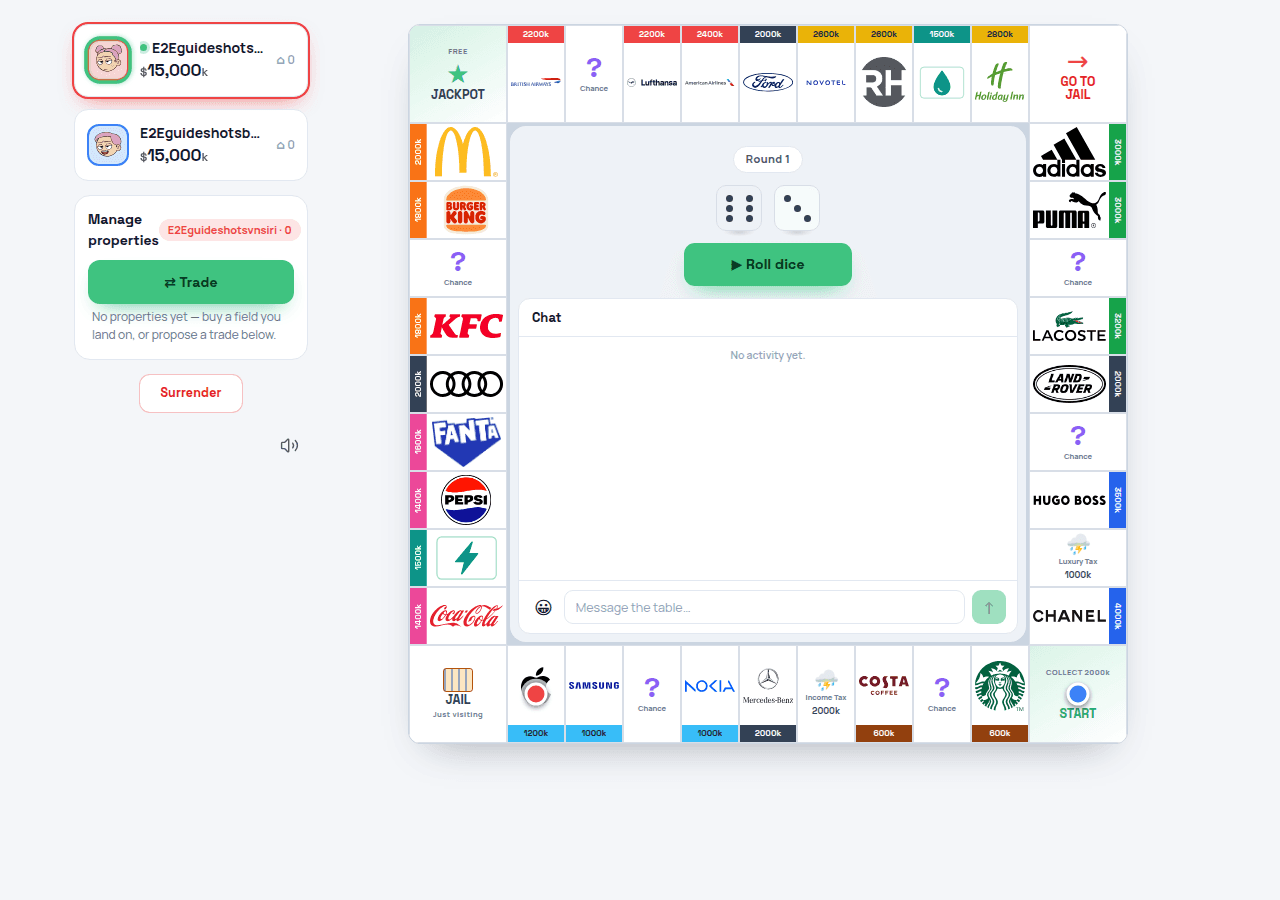
On your turn you roll two dice and move that many squares, then resolve the square you land on. Rolling a double lets you roll again; rolling three doubles in a row sends you straight to Jail.
You manage your properties (build, mortgage) and propose trades only BEFORE you roll. Once you have rolled and the square is resolved, your turn ends automatically — there is no separate "end turn" button.
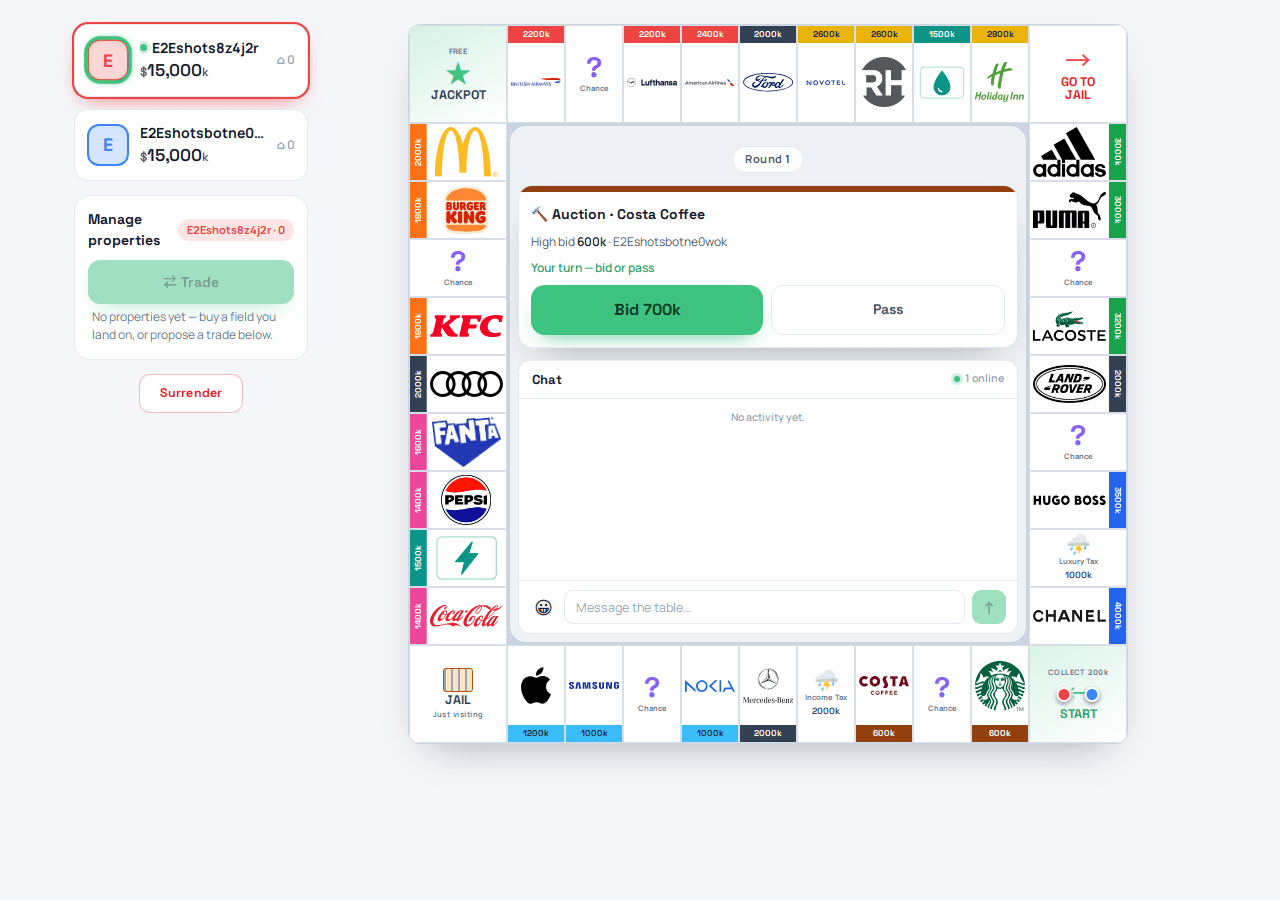
Land on an unowned company and you can buy it at its list price. Decline and it goes to auction instead — nobody is ever forced to buy, and nothing is left lying around unclaimed for long.
An auction is turn-based, not a scramble. Bidding runs in seat order starting from the player after the one who declined, the opening bid is the field's list price, and every raise after that is exactly one fixed step above the current bid.
The last player still bidding takes the field. If everyone passes, it stays unowned and the next player to land on it can buy it at list price.
Land on a company owned by an opponent and you pay rent:
A mortgaged property collects nothing. In Team mode you never pay rent to your ally — their fields are as safe for you as your own.
Once you own every street in a colour group you can build branches on them, up to five on a street. In Blitz, Classic and Team you must build evenly — no street more than one level ahead of the others in its group — and you can raise any one street by at most one level per turn. Speed drops the even-building rule so you can pour everything into a single street; the one level per turn limit stays.
Mortgage a property to the bank to raise cash quickly — you receive half its price and it stops earning rent. To lift a mortgage you pay the mortgage value plus ten per cent. You must sell every building in a colour group before you can mortgage any property in it.
In Speed a mortgage is a timer rather than a shelf: a field you have not bought back within ten rounds goes back to the bank and is free for anyone to buy, and the game counts the rounds down for you at the start of each of your turns. In Blitz, Classic and Team a mortgage never expires.
Players can trade cash and properties in both directions. Only unmortgaged, building-free properties can be traded, and you can keep three offers open at a time. The recipient can accept or decline.
To prevent gifting and collusion the two sides must be within fifty per cent of each other in value — the smaller side has to be worth at least half the bigger one. Teammates are exempt: allies may hand each other anything, including a one-sided gift.
You can propose a trade before your roll, and also while you owe a payment — dealing your way out of a debt is exactly what that pause is for.
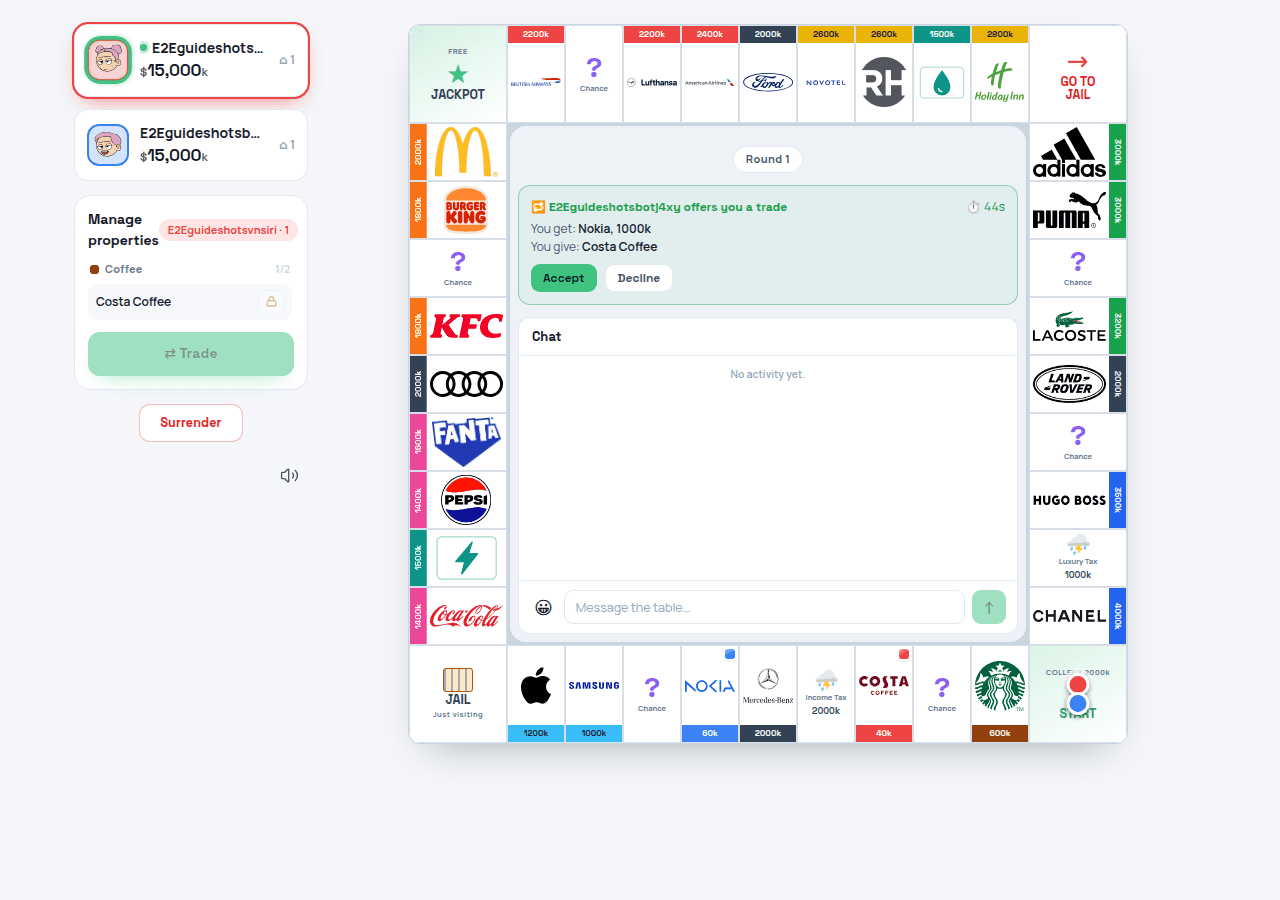
You go to Jail by landing on "Go to Jail", by drawing a Chance card that sends you there, or by rolling three doubles in a row.
There is no get-out-of-jail card in opolyx: the bail and the dice are the only two ways out.
The third corner is a dice bet rather than a rest stop. Landing on it offers you a flat stake; you pick one, two or three numbers from one to six, and a single die is rolled.
The odds are exactly even whichever way you play it — over many spins the square neither gives nor takes. Declining is free, and you cannot play at all if you are short of the stake.
Chance squares draw from a deck of sixteen cards with fixed effects — pay or collect from the bank, pay every player or collect from every one of them, pay for each branch you have built, move to another square, advance to the nearest station or utility, or go to Jail. The card you drew is named in the action log, and everyone at the table sees it.
When you owe rent or tax the game pauses and shows a "Pay" step instead of taking your cash automatically. If you are short you can sell buildings and mortgage properties to raise the money, then pay. A forced jail bail goes through the same step.
"Declare bankruptcy" is offered only when even selling and mortgaging everything cannot cover the debt. Your assets are then liquidated to the bank, the creditor is paid out of the proceeds, your properties return to the pool, and you are eliminated.
Every turn has a time limit, shown as a countdown, it is shortest in Speed, and a little shorter in Blitz than in Classic and Team. Miss your turn and it is skipped automatically; miss two in a row and you are auto-surrendered so the game keeps moving for everyone else. Building, mortgaging and trading do not reset the clock.
So that games finish, rent is taxed more and more heavily as the rounds pile up: the tenant still pays in full, but a growing share of the money leaves the game instead of reaching the owner. That drains cash out of circulation and puts weaker players under real pressure. The tax starts much earlier in Speed than in Classic and Team. In Blitz the round cap arrives long before the tax could ever start, so rent is paid in full from the first round to the last.
A game ends when one player is the last one solvent, or when the round cap is reached — in which case the richest player by net worth wins. In Team mode it ends with the last team standing, or with the team holding the larger combined net worth at the cap.
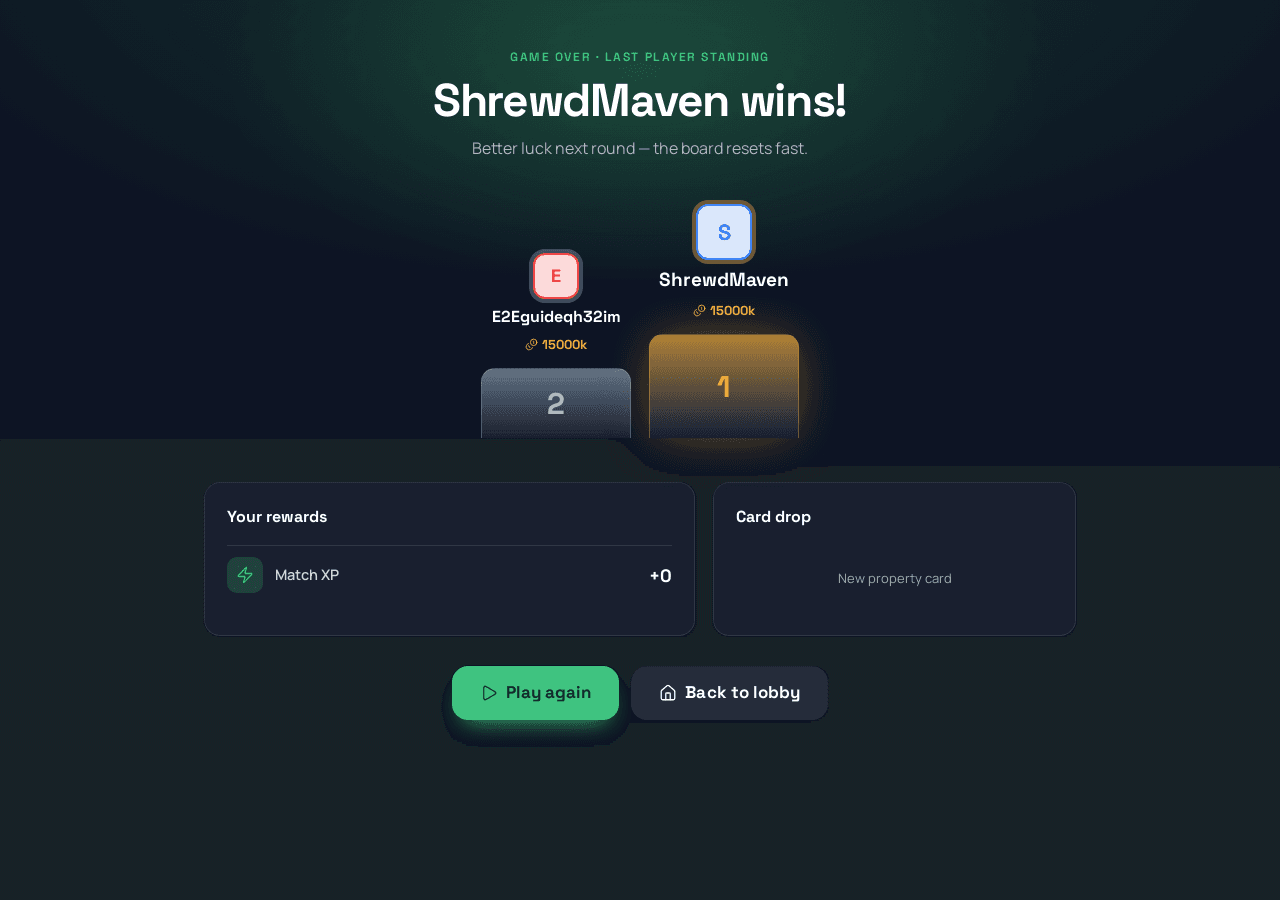
Every seat earns XP from a finished game, not just the winner. How much depends on where you placed, how many complete colour groups you were still holding at the end, and whether you survived to the finish. Games that end in the first few rounds pay nothing, so a quick surrender is worth nothing to farm.
XP raises your level, levels carry a rank, and certain levels drop a collectible card — which is where the rent boost described under Rent comes from. The exact amounts and the full level table are on the progression page linked below.