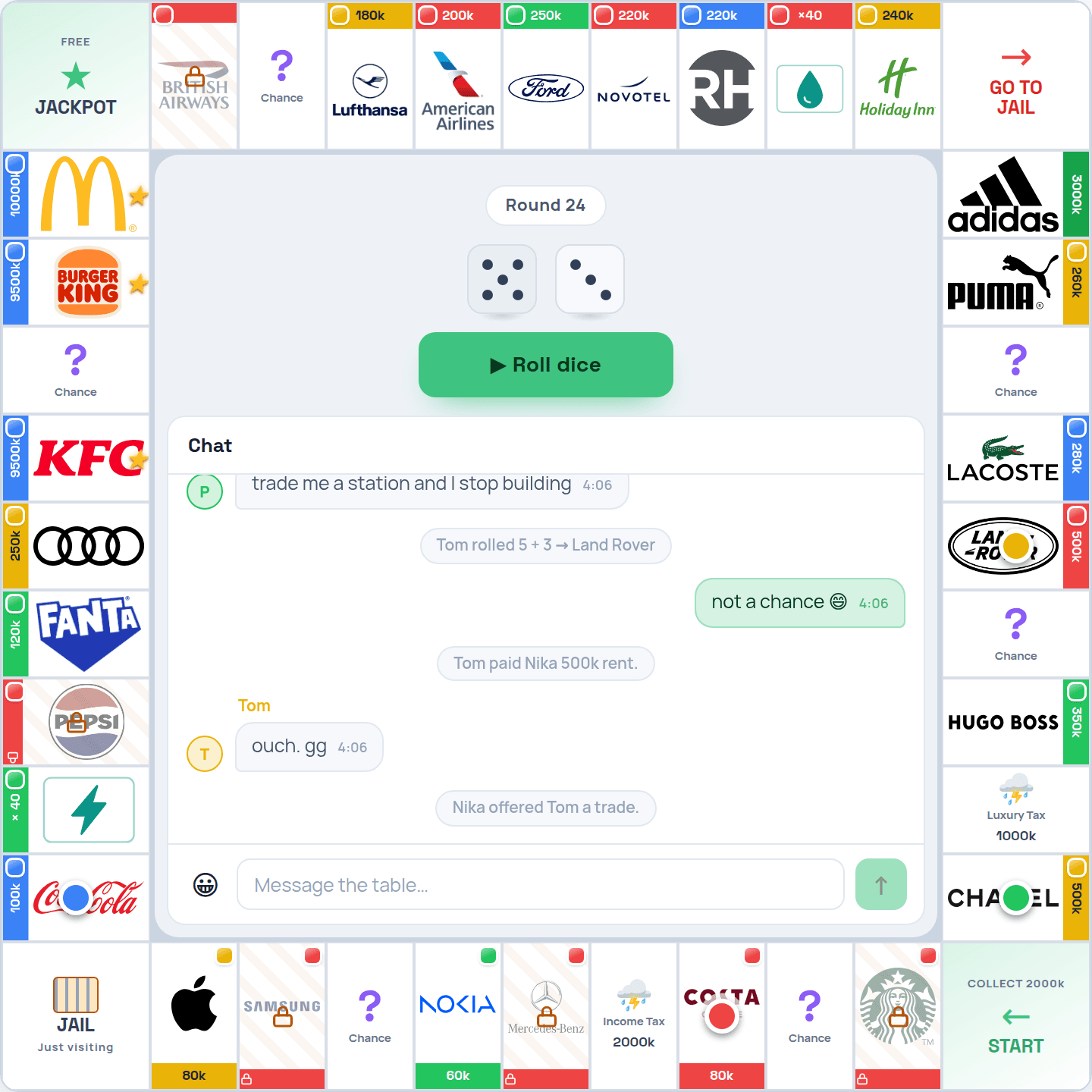
opolyx Classroom: a whole class plays, the teacher watches
Teachers can now open a class: one code for every student, private tables, every table on one screen, a money report for each student and 8 ready lessons.
In plain words
opolyx Classroom is for teachers of financial literacy, economics and maths. Open a class, put its code on the board, and when you start the lesson the whole class sits down at tables of its own. You watch every table as it plays, end the lesson when the bell rings, and read every student’s money afterwards.
A lesson in five steps
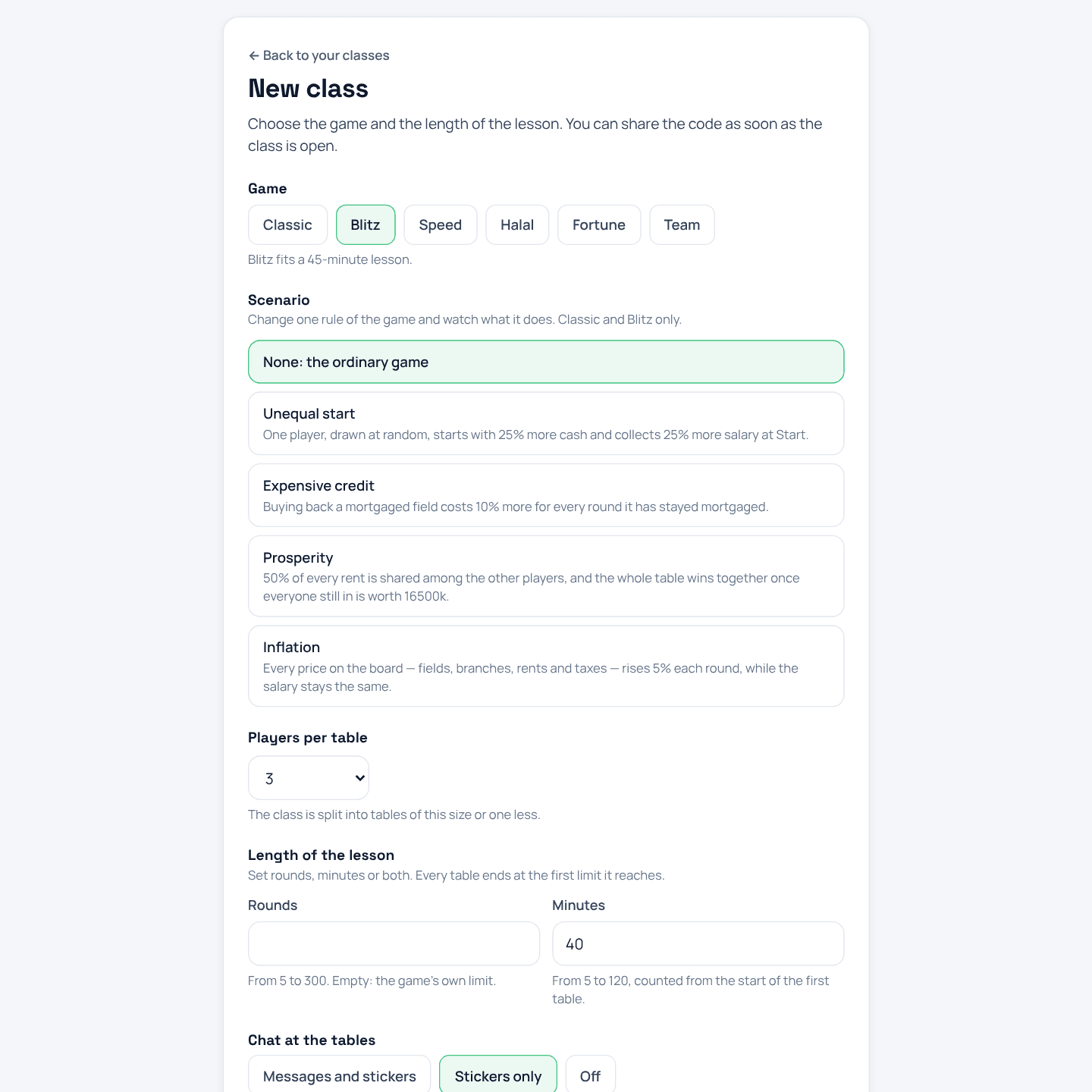
- Open a class: choose the game — Classic, Blitz, Speed, Halal, Fortune or Team — the players per table, how long the lesson lasts, in rounds, minutes or both, and the chat: messages and stickers, stickers only, or off.
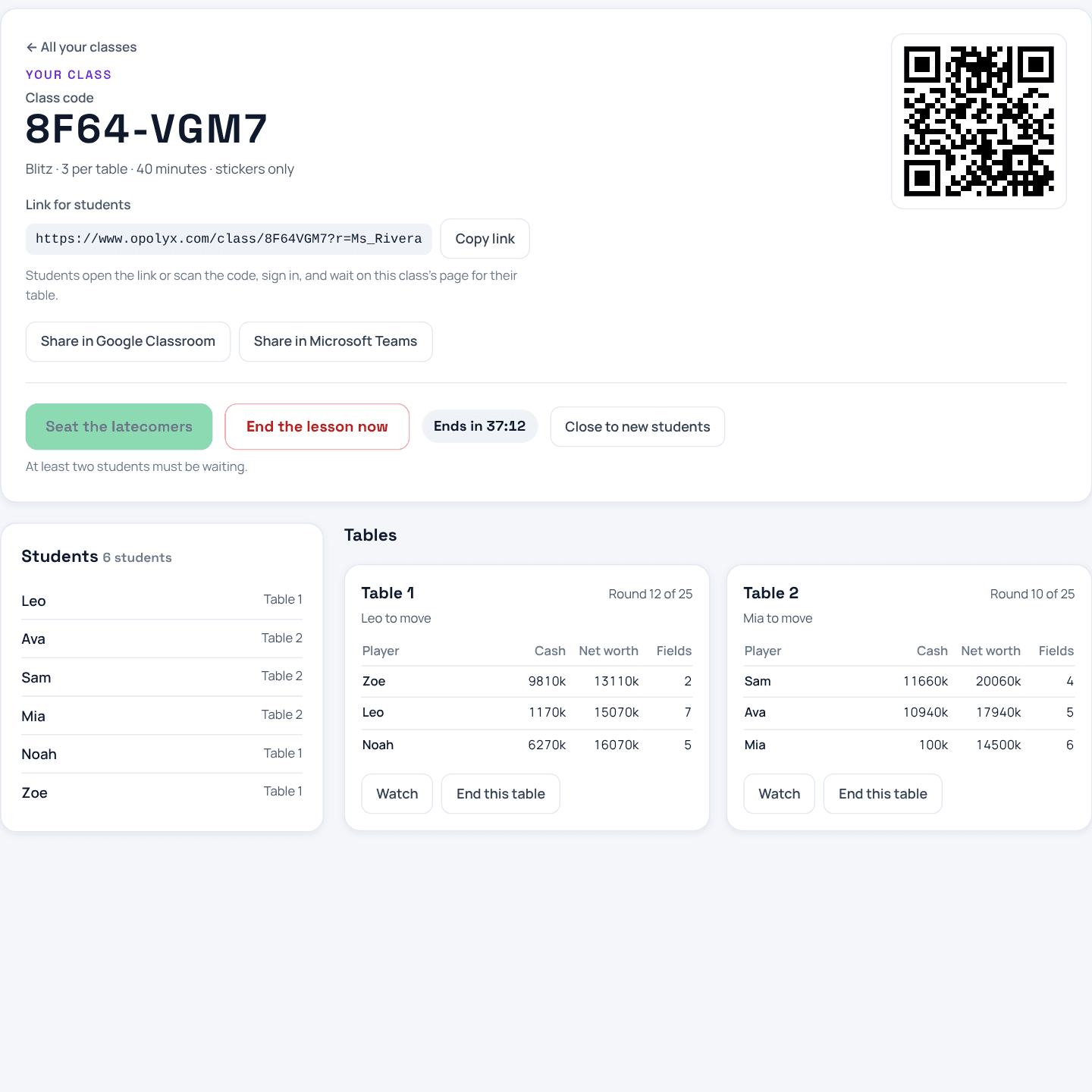
- Share it: a code and a QR code for the board, or a link for Google Classroom, Microsoft Teams or the class chat. Students sign in and wait on the class’s page.
- Press “Start the lesson”: the class is split into tables of 2 to 6 whose sizes differ by at most one, and nobody from outside the class can sit down. Students who come late are seated with “Seat the latecomers”.
- Watch every table on one screen — its round, whose turn it is, each student’s cash and net worth — and open any table to follow it. When the bell rings, “End the lesson now” ends every table, and at each one the highest net worth wins.
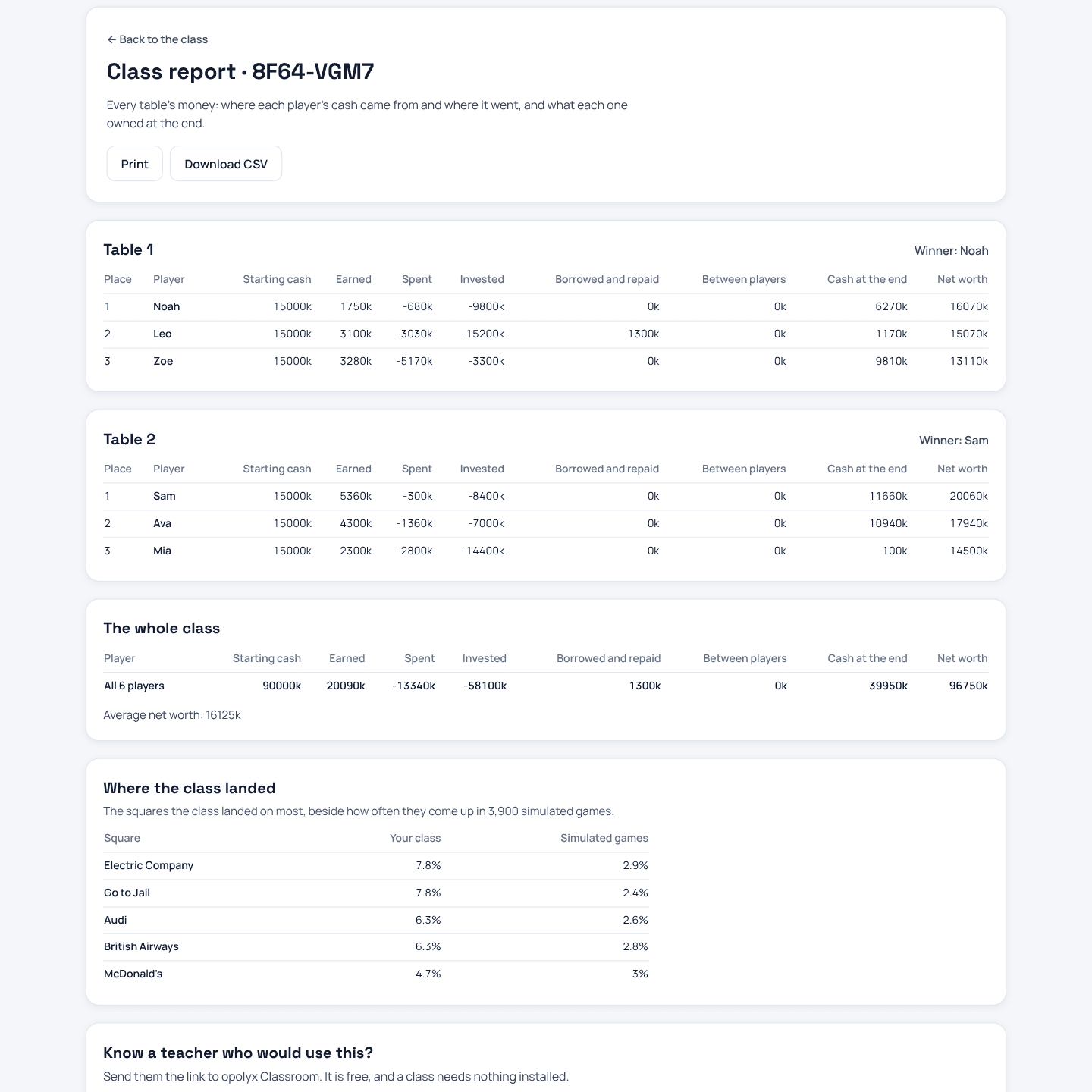
- Then “Open the class report”: every table’s standings and each player’s money report — where their cash came from and went, and what they owned at the end — ready to print or download.
8 lessons, each one school period
Each lesson fits a 45-minute period: its goals, a plan minute by minute, a worksheet to print, questions filled in with your own class’s figures, and homework. “Run this lesson” opens a class with its settings already chosen. The topics: cash or net worth, borrowing and interest, return and payback, risk and the emergency fund, inflation, taxes and shared money, auctions and fair trades, and the Landlord’s Game, the game Monopoly grew out of.
Scenarios: change one rule and watch what it does
- Unequal start: one player, drawn at random, starts with 25% more cash and collects 25% more at Start.
- Expensive credit: buying back a mortgaged field costs 10% more for every round it has stayed mortgaged.
- Inflation: every price on the board rises 5% each round, while the salary stays the same.
- Prosperity: 50% of every rent is shared among the other players, and the whole table wins together once everyone still playing is rich enough.
The experiments page shows what each scenario changes, measured over 4,000 simulated games with the rule and the same 4,000 without it.
Questions teachers ask
Is opolyx Classroom free?
Yes. Opening a class and every lesson cost nothing, and a class needs nothing installed.
Do students need an account?
Yes. Each student signs in like any player, under our Terms of Service, and joins with the class’s code or link.
Can someone outside the class join a table?
No. A class’s tables never appear in the lobby, and only the class’s students are seated at them. You can also close the class to new students.
What happens to a class’s data?
A class’s records are deleted 90 days after it ends; the games themselves stay, as every game does.
For the technically curious
A class table is an ordinary game that starts already running, so the lobby never lists it and nobody can join it from there. The teacher’s page asks the game server about every table every five seconds.
The server shuffles the class and cuts it into tables whose sizes differ by at most one. A Team class sits at tables of four or six, two sides at each, so nobody’s side is ever short.
A scenario is written into the game when it starts, like a mode’s own rules, so nothing changes in the middle of a lesson. A test plays the same games with the scenarios’ code and without it, to prove that an ordinary game is not changed at all.