One email a day at most, and asking to leave works at once
Two changes about your account and your inbox. Ask us to delete your account while signed in, and it is deactivated and unsubscribed the moment you send the form — with a button to undo it. And whatever we have to tell you, you now get at most one email from us a day.
In plain words
Until 18 September, asking us to delete your account was a note in a table and nothing more. The account went on working and the emails went on arriving until somebody acted on the request — and of the first 33 people who asked, 10 kept playing afterwards, because nothing had stopped them.
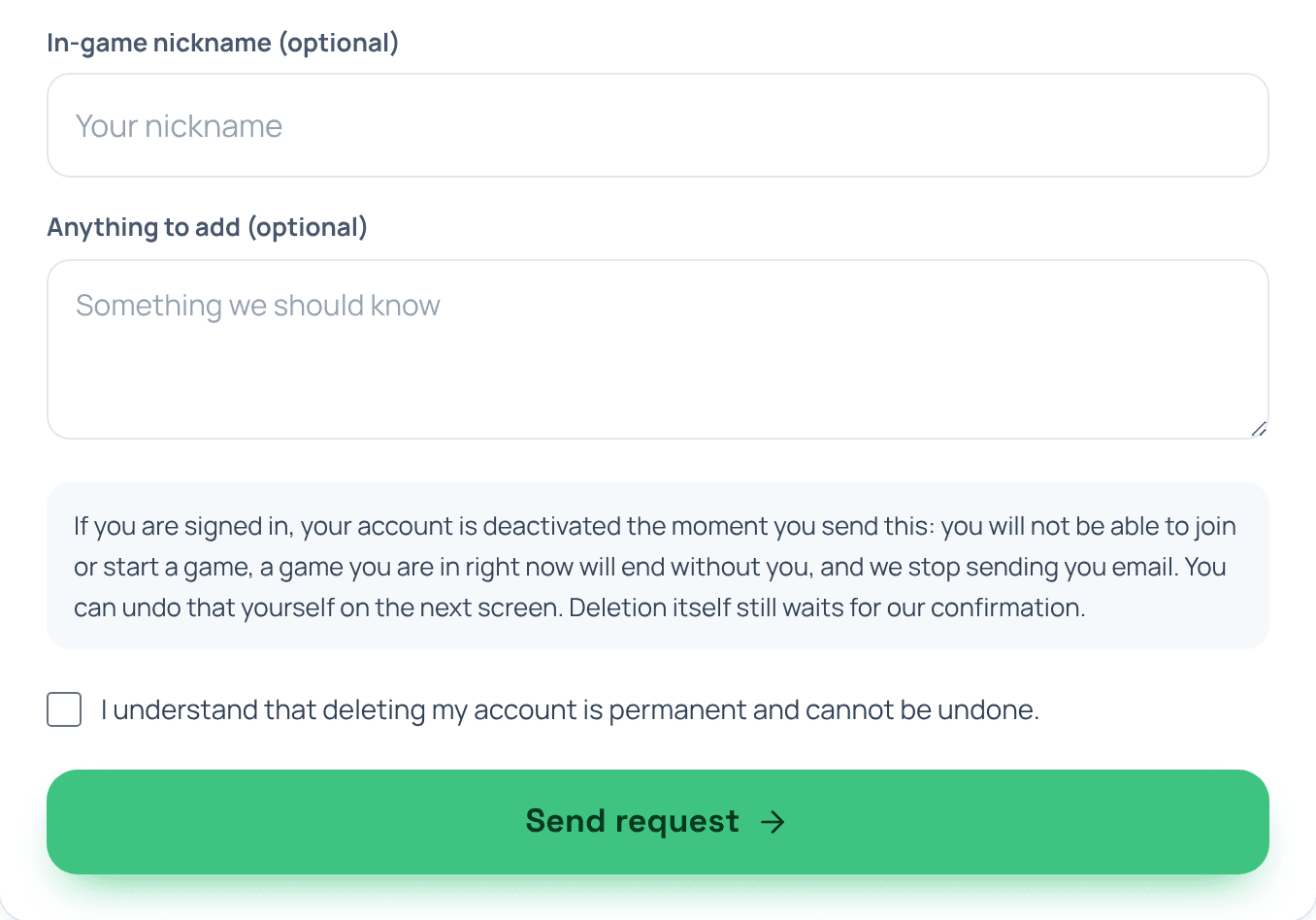
Now, if you are signed in when you send the deletion form, it takes effect at once. Your account is deactivated: you can still sign in and look around, but you cannot start or join a game, and a game you are in right now ends without you. And you are unsubscribed from every email we send. Since the change, all 36 players who asked had both happen the moment they pressed “Send request”.
Changed your mind? The next screen has a Cancel my request button, and pressing it gives you your account back straight away. You stay unsubscribed, though — we never put anyone back on a mailing list they left, not even by accident. 3 players have used it so far.
If you are not signed in, the form only records the request, and nothing happens to any account. That is deliberate: a form anyone can fill in with any address must never be able to lock a stranger out of their own game.
At most one email a day
The other change is about our emails. opolyx sends only a few kinds — a nudge if you signed up but never finished a game, a few notes in your first month, a note if you have not played for a while, news about VIP — and until now each one decided on its own when to write. One rule now sits above all of them: no player gets more than one email from us in any 24 hours. In the week before the rule, 12 players got two less than a day apart; since 30 September, across 2,444 emails, nobody has.
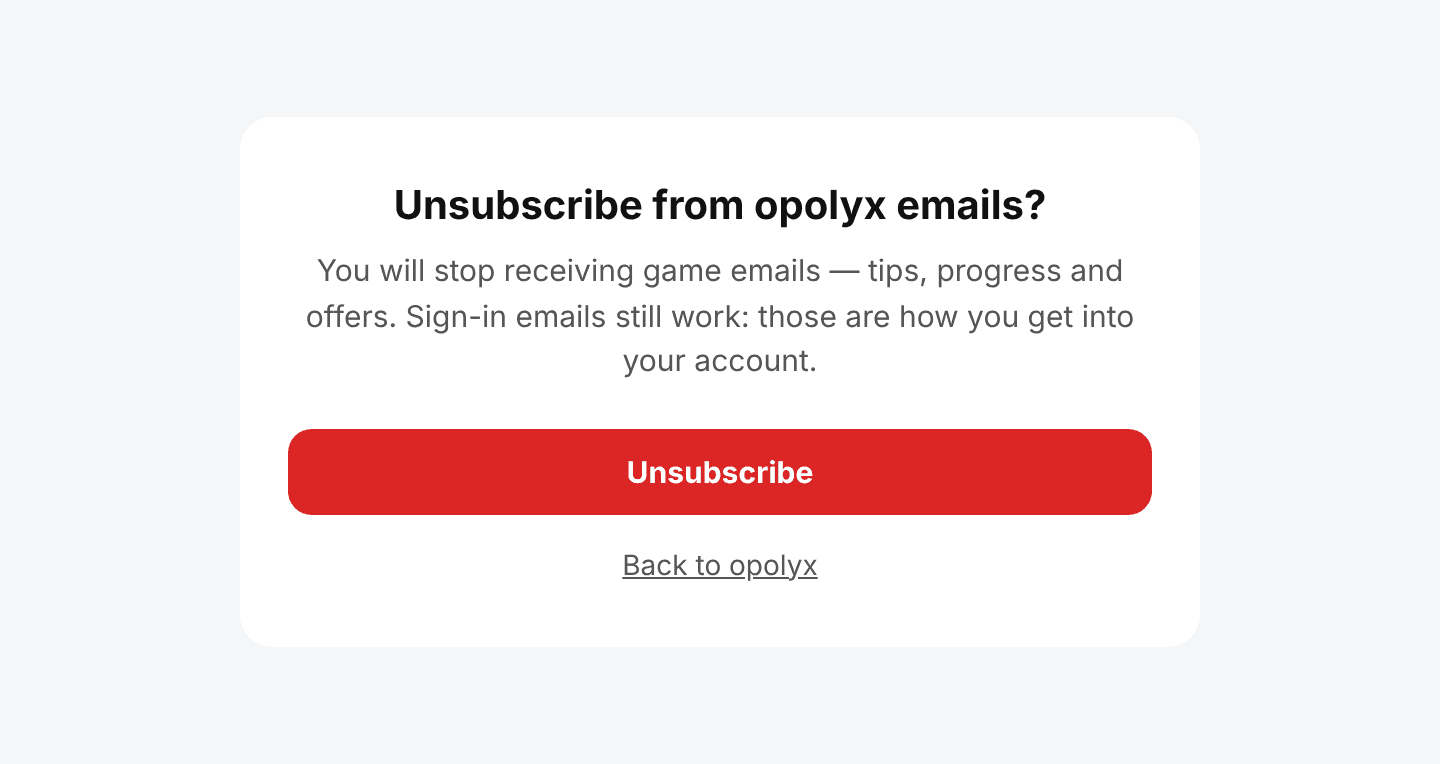
And the unsubscribe link now asks before it acts. Some mail services open every link in an incoming message to check it for danger — which, for an unsubscribe link, meant unsubscribing people who had never clicked anything: 26 of 119 opt-outs had arrived less than 15 seconds after the email that carried them. The link now opens a page with a button on it. Unsubscribing from your mail app’s own menu, in Gmail or Yahoo, still works in one click.
Questions people ask
How do I delete my opolyx account?
Sign in, open the account deletion page — it is linked at the bottom of every page — and send the request. From that moment your account is deactivated and unsubscribed from every email we send, and the request reaches our team.
Can I undo a deletion request?
Yes. The screen that confirms your request has a Cancel my request button, and pressing it gives you your account back straight away. You stay unsubscribed from our emails: we never sign anyone back up.
How many emails does opolyx send?
At most one a day, whatever kind it is. There are only a few kinds: a nudge if you signed up but never finished a game, a few notes in your first month, a note if you have not played for a while, and news about VIP.
How do I unsubscribe from opolyx emails?
Use the unsubscribe link at the bottom of any email from us: it opens a page that asks you to confirm with a button. Unsubscribing from the menu of Gmail or Yahoo still takes one click.
For the technically curious
The deactivation is a single statement in the database. It sets the account’s flag only if it is not set already, and records exactly the value it wrote — and that record is what makes the Cancel button safe. Cancelling lifts the flag only where it still holds that same value, so an account an administrator had blocked stays blocked even if its owner files a request and withdraws it. A cancel button can undo a request; it can never undo a ban.
It acts on the account you are signed in as, never on the address typed into the form. A signed-out request can be typed by anyone, about anyone, which is exactly why it changes nothing on its own.
The one-a-day rule is decided at the moment an email is claimed for sending, under a lock, against every kind of email at once. Two different emails that fall due in the same hour cannot both slip through, because only one of them can win the claim; the other simply waits for a later day.
The unsubscribe page answers a plain visit — which is all a link scanner ever makes — with a question, and acts only when the button is pressed. The one-click unsubscribe that Gmail and Yahoo offer from their own menus (RFC 8058) is a separate request, and it still unsubscribes at once.
Bounces and spam reports reach us from our email provider as signed notifications. A permanent bounce or a complaint marks the address as unsubscribed, exactly as the link would; a temporary failure — a full mailbox, a server briefly down — does not.