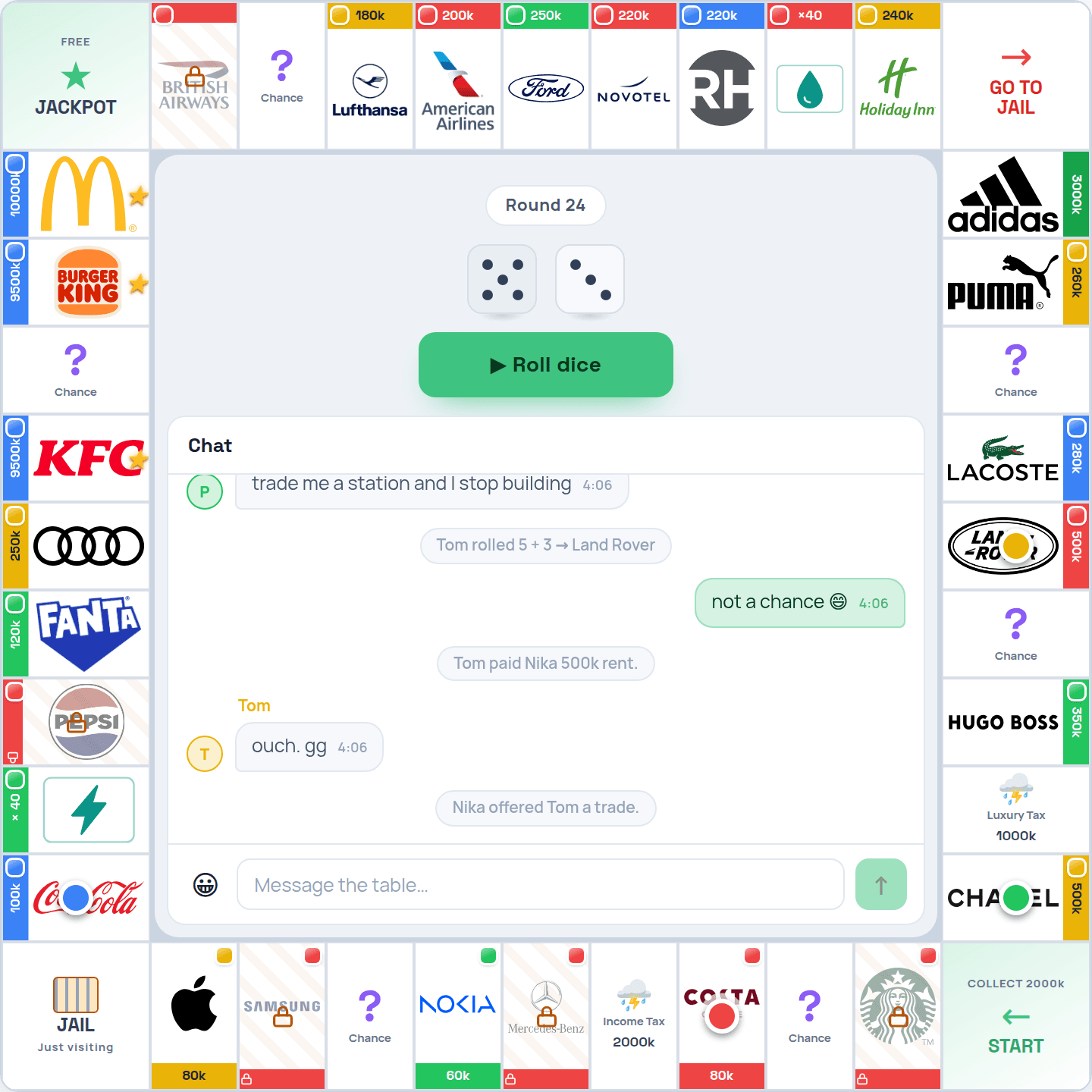
The Chance deck is shuffled now — no more fixed order
Until 4 October every game drew its Chance cards in the same fixed order, so the first card anyone turned over was always school fees. Now each draw is a random card from those not yet drawn, every card still comes up once per pass, and the order is a surprise again.
In plain words
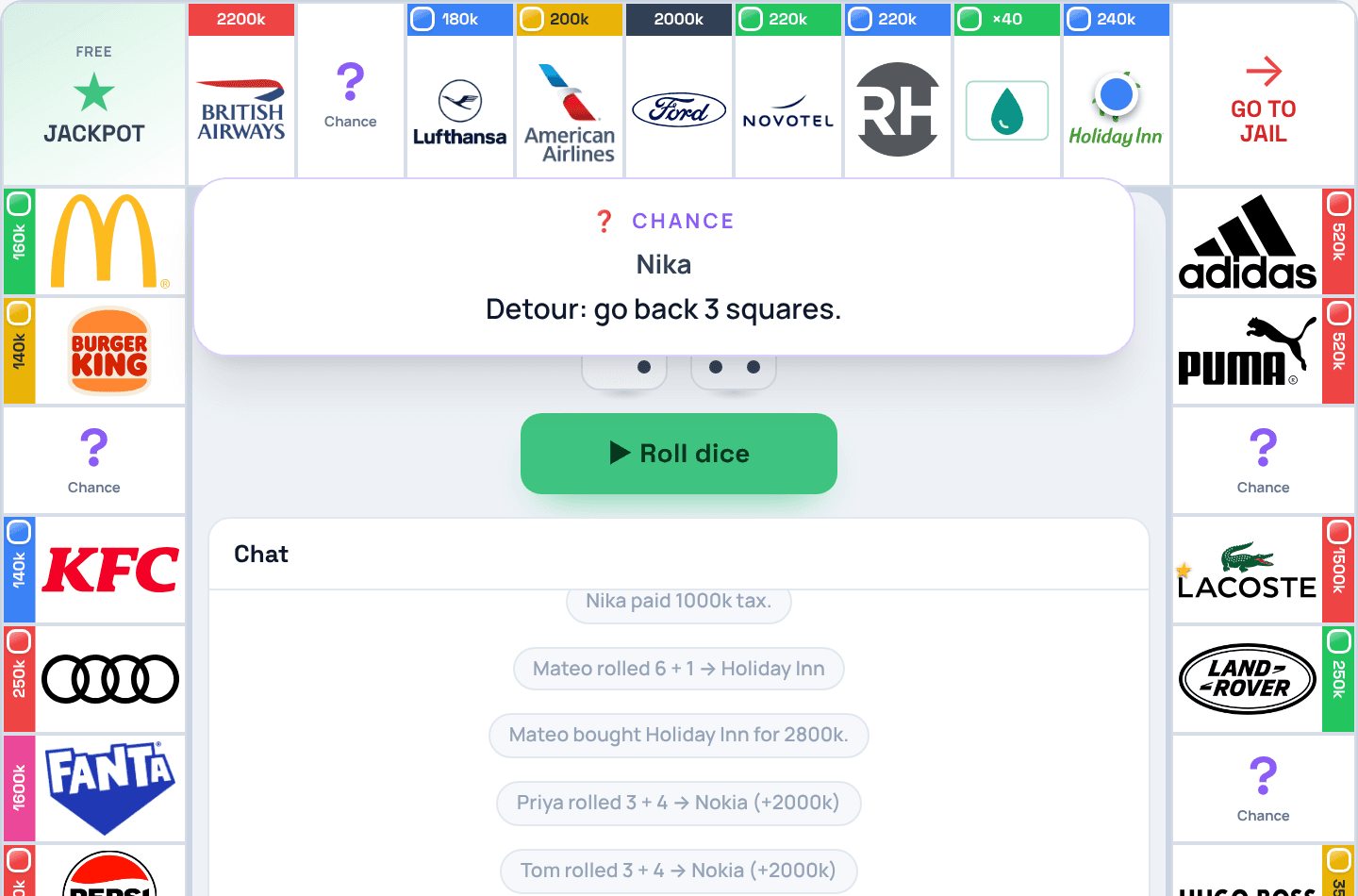
Chance is a deck of 16 cards — pay school fees, collect a tax refund, go to jail, take a detour — and it was never shuffled. Every game drew the cards in the same order, starting from the top of the same list. So the first Chance card of every game was school fees: in the week before the change, all 2,261 games that drew a Chance card opened with it. Anyone who had played a few games could have named the next card before it was turned over.
What changed on 4 October
Now each draw picks a card at random from the ones not yet drawn in this pass through the deck. Once all 16 have come up, the whole deck is back in play and the next pass starts fresh. Every card still comes up exactly once per pass, so the deck's balance — how much money it hands out and takes back, how often it sends someone to jail — is what it always was. What changed is the order: nobody knows it in advance, not the players and not us.
Questions people ask
Are the Chance cards shuffled in opolyx?
Yes. Since 4 October 2026 each Chance draw is a random card from the ones not yet drawn in the current pass through the deck of 16, so the order is a surprise — to every player, and to us.
Can the same Chance card come up twice in a row?
Not within a pass: once a card is drawn it stays out until all 16 have come up. Only when a new pass begins can the last card of the old one come up again straight away.
Is counting cards allowed?
Yes. Every card drawn in the current pass is in the game log, which everyone at the table can read, so you can work out which cards are still to come — just not which of them comes next.
Did the shuffle change how much money Chance gives or takes?
No. Every card still comes up exactly once per pass, so over a game the deck hands out and takes back what it always did. Only the order changed.
For the technically curious
The engine used to keep a pointer into a fixed list of cards and take whichever card sat at that position, wrapping around after the last one. Nothing on that path ever asked the random-number generator, so the order of the deck was simply the order the cards are written in. Now the draw does ask it: it picks evenly among the cards not yet drawn in this pass, using the same per-move random source as the dice — the one seeded with a secret that only the server holds.
The obvious alternative was turned down on purpose: shuffle the whole deck once when the game starts, and store the order. The state of a game is readable by every seat at the table — it is how each player’s screen knows what to draw — so a stored order would be a published order, and anyone who looked could read the next card. The only thing stored is the pile of cards already drawn, and that pile is public anyway.
| First Chance card of a game | Week before the change | Since 4 October |
|---|---|---|
| Games that drew a Chance card | 2,261 | 1,006 |
| Opened with school fees | 2,261 (100%) | 83 (8.3%) |
| Different cards that opened a game | 1 | 16 |
Is 8.3% for school fees suspicious? No. With 16 cards and 1,006 games, some card has to come out on top, and this spread is what a fair shuffle produces: a chi-square test across all 16 gives p ≈ 0.17, nowhere near a warning. The rarest opening card has still opened 51 games, 5.1% of them.
While we were in the deck, two card texts were fixed in all 15 languages. Detour told you to “go back -3 squares” — an internal minus sign leaking into the sentence — and Get inspired sent you to “position 11”, a number on our side of the board, instead of naming the square.