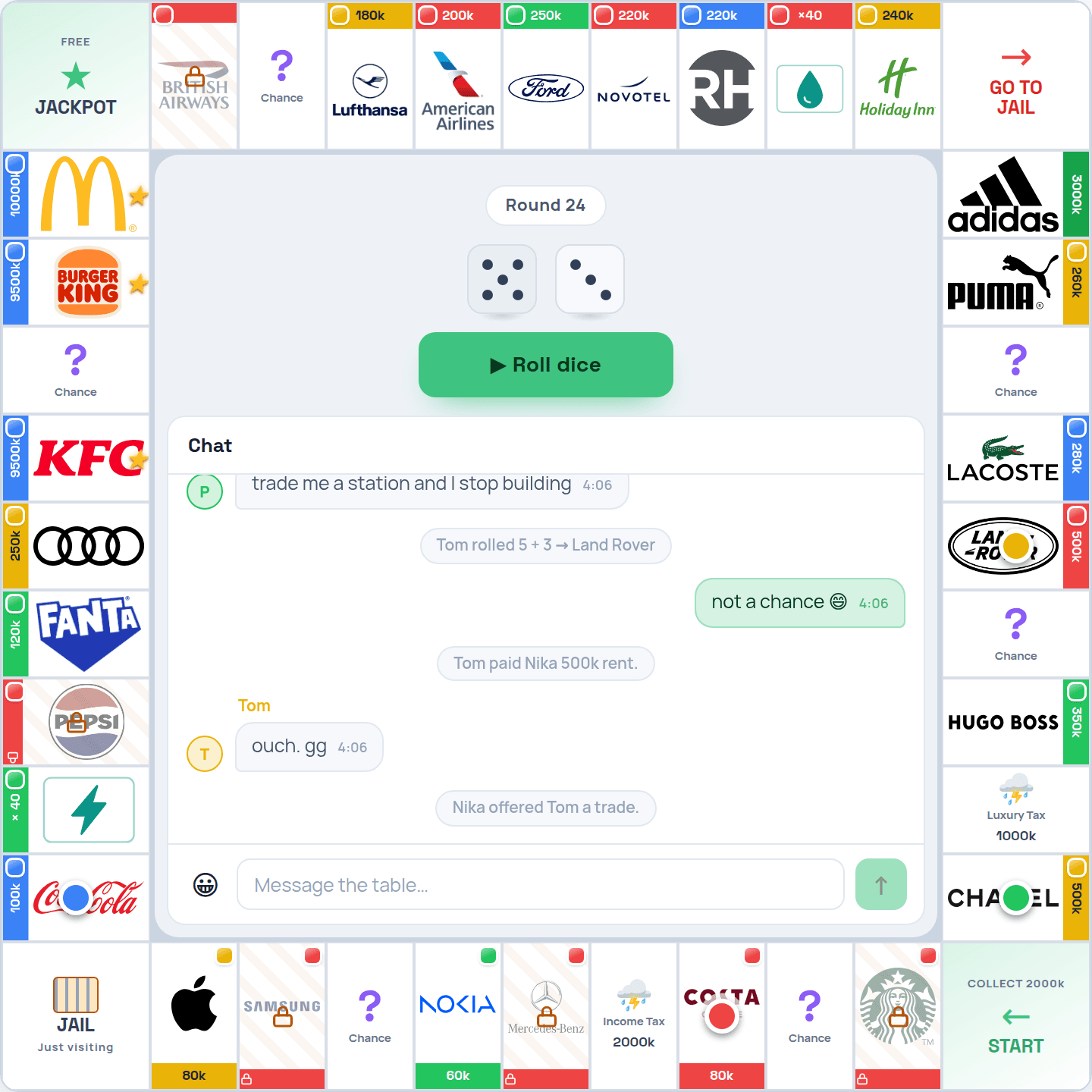
VIP now takes cards, Apple Pay and Google Pay
VIP is a bank that lends to you in the middle of a game. Until now the only way to pay for it was cryptocurrency. A bank card, Apple Pay or Google Pay works too, and the price is the same whichever you pick.
In plain words
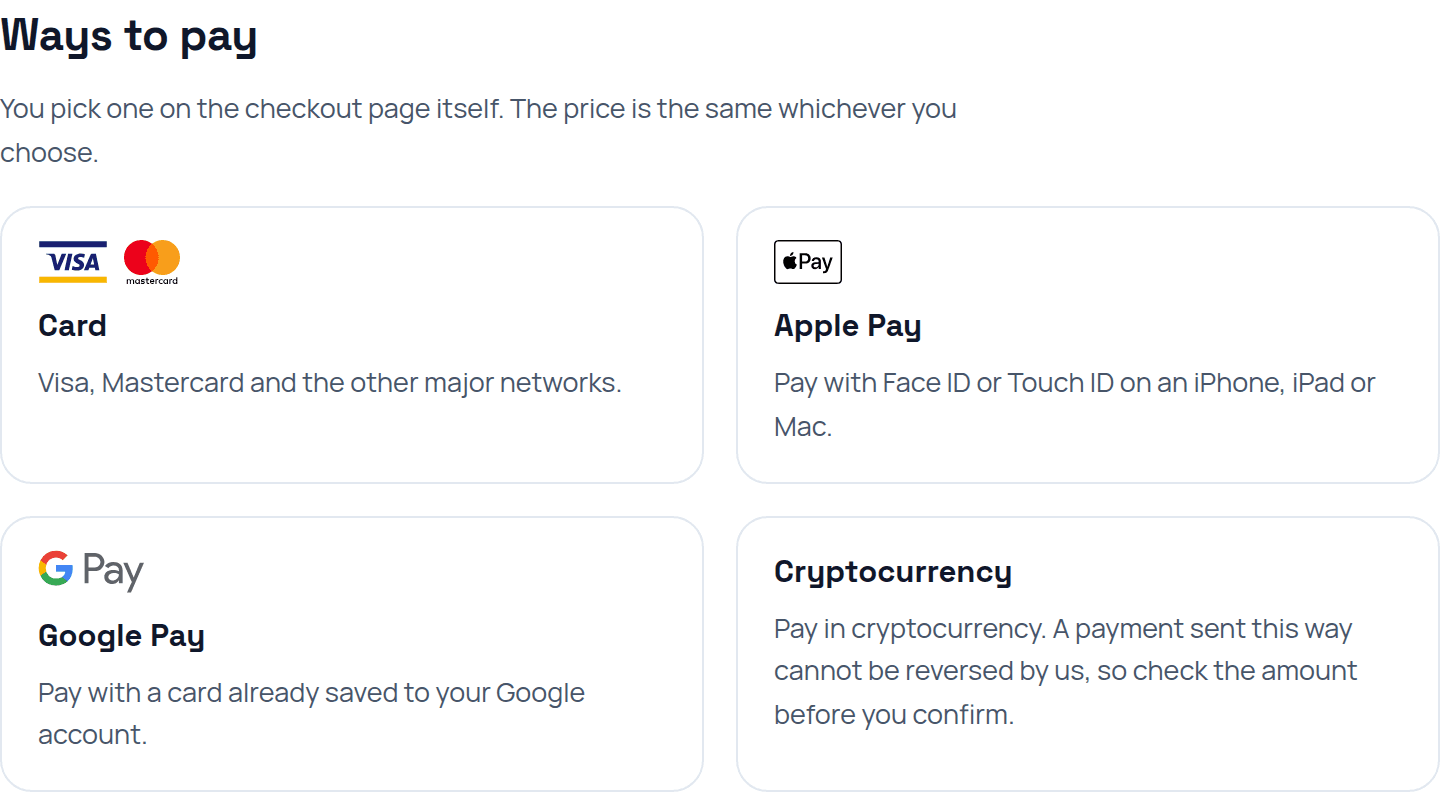
Paying for VIP used to mean paying in cryptocurrency, which is a fine way to pay if you already hold some and an impossible one if you do not. You can now pay with an ordinary bank card, or with Apple Pay on an iPhone, iPad or Mac, or with Google Pay from a card already saved to your Google account. Cryptocurrency has not gone anywhere — it is still there, as one choice among several. You pick on the checkout page itself, and the price is identical whichever you choose.
Which way should I pay?
| Way to pay | Who you are paying | Refundable | Pick this if |
|---|---|---|---|
| Bank card | Dodo Payments | Yes | You want the ordinary thing. Visa and Mastercard both work. |
| Apple Pay | Dodo Payments | Yes | You are on an iPhone, iPad or Mac and would rather not type a card number at all. |
| Google Pay | Dodo Payments | Yes | You already have a card saved to your Google account. |
| WeChat Pay | Dodo Payments | Yes | You already pay with WeChat on your phone. |
| Cryptocurrency | trybit | No | You hold some — or you are somewhere a card to a foreign merchant tends not to go through. |
What VIP actually is
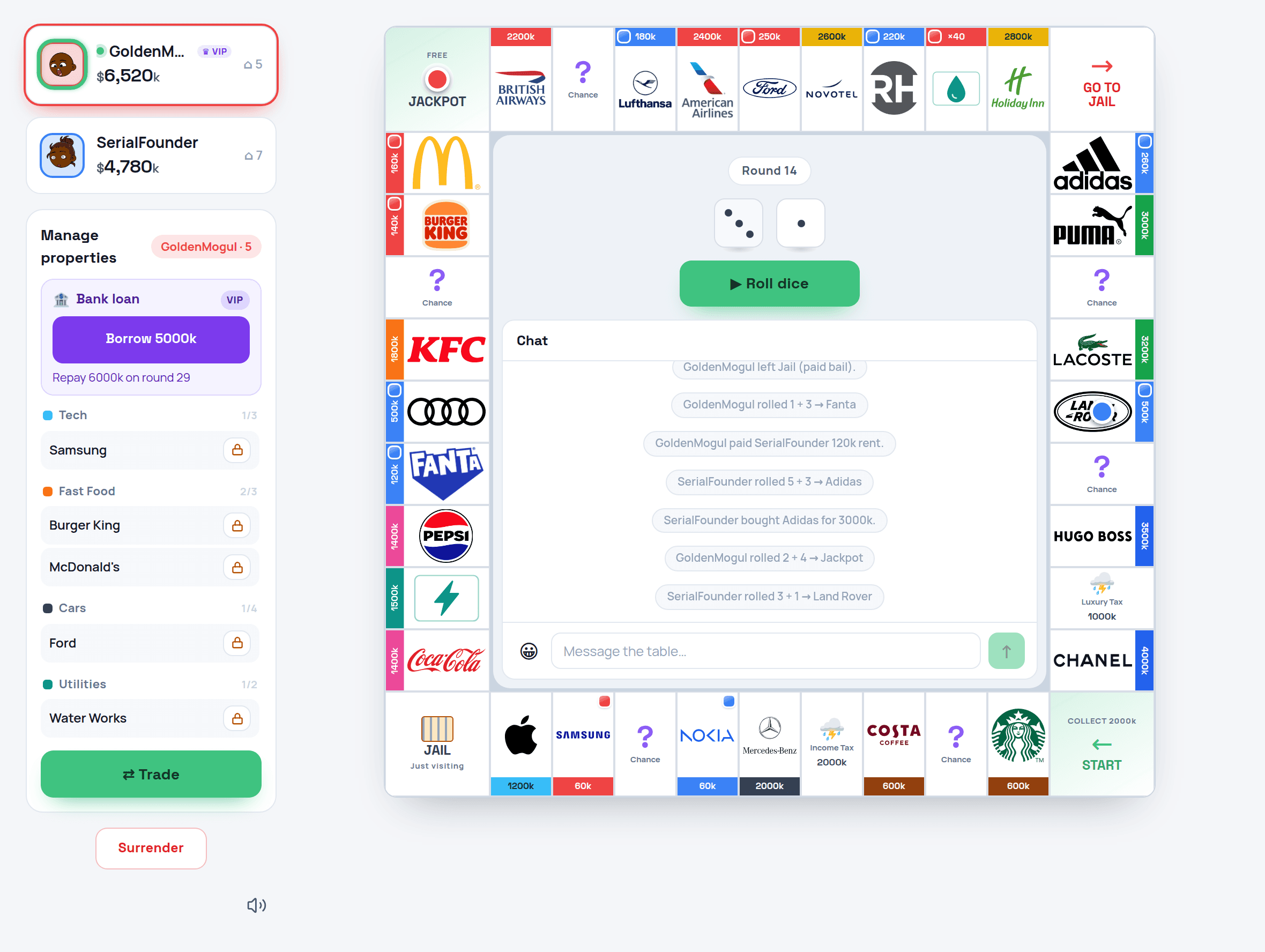
If you have not run into VIP yet, here is the whole of it, because it is the only thing on this site that costs money. It gives you a bank that will lend you cash in the middle of a match — including in the middle of a payment you cannot cover, which is exactly the moment it is worth having — and a crown beside your nickname so everyone at the table can see you took it. You repay more than you borrowed, so the loan only pays off if you turn the cash into property. Nothing else in opolyx is behind a payment: every mode, every board and every seat is open from your first game, and you can start and finish a full match without spending anything.
| What you get | Free | VIP |
|---|---|---|
| Every mode and every board | ✓ | ✓ |
| Every seat at every table | ✓ | ✓ |
| A full game, start to finish | ✓ | ✓ |
| Ranked play and the leaderboard | ✓ | ✓ |
| A bank that lends to you mid-game | — | 5000 → 6000 |
| A crown beside your nickname | — | ✓ |
Questions people ask
Is opolyx free to play?
Yes, and not in the thin sense the word usually carries. Every mode, every board and every seat is open from your first game; nothing runs out and there is no waiting to play again. VIP is the only thing that costs money, and it buys one extra mechanic rather than access to anything.
How much does VIP cost?
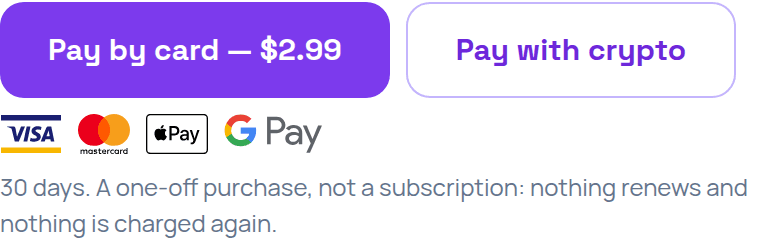
$2.99 for 30 days, the same on every payment method. There is no larger plan and no smaller one.
Does VIP renew automatically?
No. It is a one-off purchase of a fixed number of days, not a subscription — nothing is charged again and there is nothing to remember to cancel. Buying again while it is still running adds to the days you already have instead of replacing them.
Which cards can I use?
Visa, Mastercard and the other major networks, credit or debit. The card page is the payment provider’s own, so it shows you which networks it will take before you enter anything.
Can I pay with Apple Pay or Google Pay?
Yes. Apple Pay on an iPhone, iPad or Mac, and Google Pay with a card already saved to your Google account. Both are offered on the same checkout page as the card form, and both cost the same.
Can I still pay with cryptocurrency?
Yes. Crypto was the only way to buy VIP until cards arrived and it has not gone anywhere — it is one choice of several now. It is also the route that still works where a card to a foreign merchant does not.
Can I get a refund?
For a card, Apple Pay or Google Pay payment, refunds are handled by Dodo Payments, who are the seller of record for that transaction. Write to support@opolyx.com and we will put you in touch. A cryptocurrency transfer is different and the difference is not a policy choice: once it has been sent it cannot be reversed, by us or by anyone.
Do you store my card details?
No, and we never see them. The card form belongs to the payment provider; what comes back to us is whether an invoice was paid and for how much. We keep the plan, the amount, the provider’s reference and the date, because we have to be able to show what you bought and for how long.
For the technically curious
Card, Apple Pay and Google Pay payments are handled by Dodo Payments, which acts as the merchant of record. That is a real distinction rather than a formality: they are the seller of the transaction, they issue your invoice, and they are the ones responsible for any VAT or sales tax wherever you happen to be buying from. Cryptocurrency goes through a different provider, trybit, which acts as a gateway only — on that route opolyx is the seller, and a transfer cannot be reversed by us or by them once it has been made.
Your card number never reaches opolyx. The checkout page belongs to the payment provider, you enter your details there, and what comes back to us is only whether an invoice was paid and for how much. We keep a record of the purchase — which plan, what amount, the provider reference and the date — because we have to be able to show what you bought and for how long, and that is all of it.
The checkout is pinned to US dollars on purpose, and it is worth explaining why, because the default would have been worse. Payment providers routinely offer to price a checkout in the buyer’s local currency, which sounds friendly and means the amount that arrives is no longer the amount the page advertised. Our own check compares what was paid against what VIP costs, so a checkout that quietly re-priced itself in euros would have been refused with the money already taken. Pinning the currency means the page, the invoice and the check all name the same number.
How a payment becomes VIP
Three things have to be true before a payment turns into VIP, and any one of them failing stops it. The notification arrives signed, and the signature is checked against a secret only we and the provider hold — so a forged message is refused before it is read. The order reference on it has to resolve to an invoice we ourselves issued, not merely to a real payment somewhere. And then the provider is asked directly what was actually paid, and that amount is compared against what VIP costs. Only then is the time granted. Every one of those gates fails closed: anything we do not recognise is refused and written to the log rather than waved through.
If you close the tab
Opening a checkout and then walking away is the commonest thing that happens to a payment page anywhere, and until recently it left the attempt sitting open on our side for the better part of a day before anything wrote it off. That is now an hour. Paying late still works, which is the part worth knowing: a payment that lands after the write-off is honoured anyway, because VIP is granted against the payment itself and never against our record of the attempt.