Why can’t I build? The board now tells you
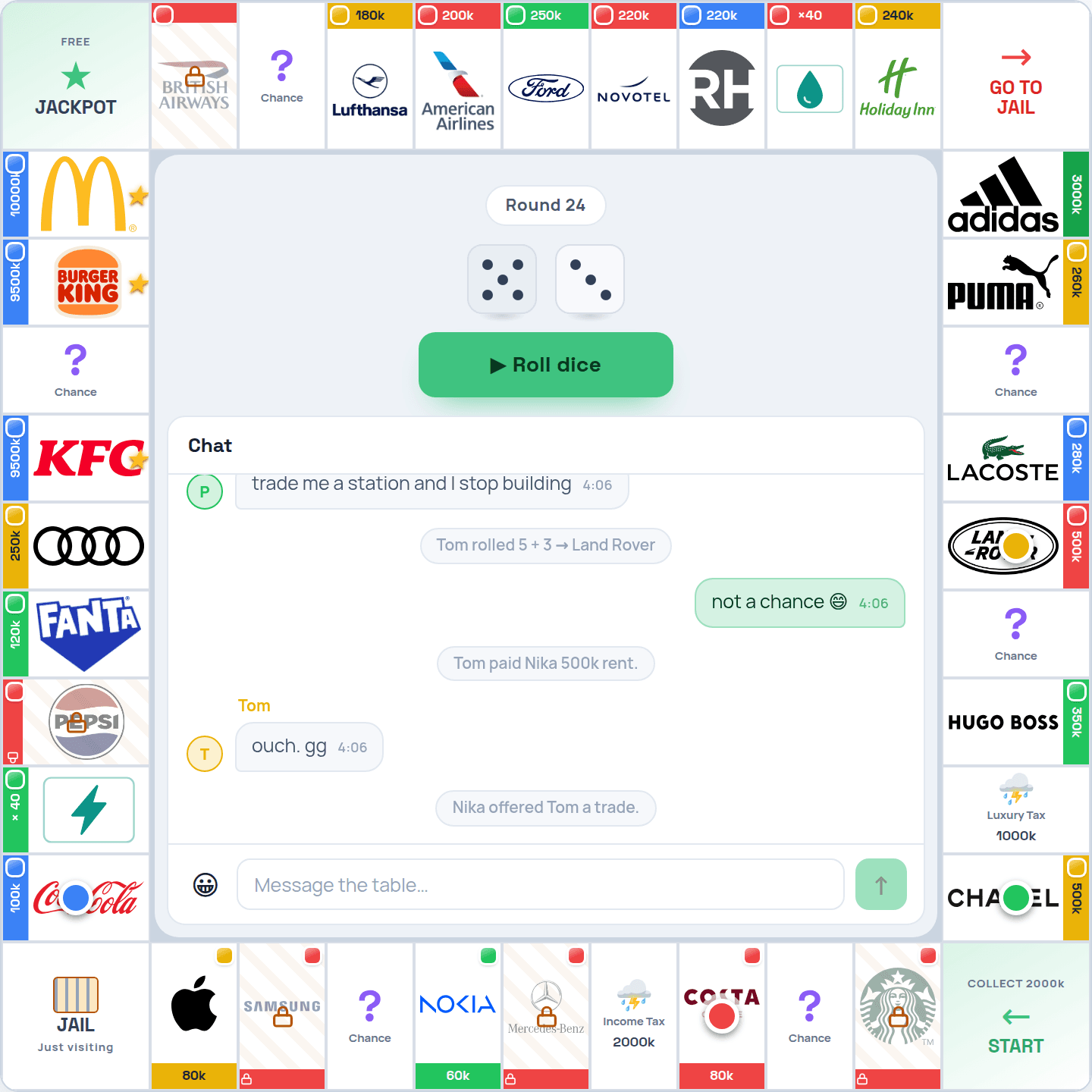
The build button used to vanish, without a word, whenever you did not own a whole colour set — the most common position on any board. Now it shows on every street you own and says why it is greyed out; the padlock and the stars are labelled, the rent tax shows on both sides of a payment, and every refusal speaks your language.
In plain words
The question players asked most in our chat was some version of “how do I build?” — 51 times, from 35 different players, in several languages. They had a point. The build button only appeared once you owned an entire colour set, so a player holding two streets of three saw no button and no explanation, which is the ordinary state of most boards for most of a game. Of the players still in at the end of a game, 371 of 1,110 had never built anything at all, and 304 of those owned three or more properties.
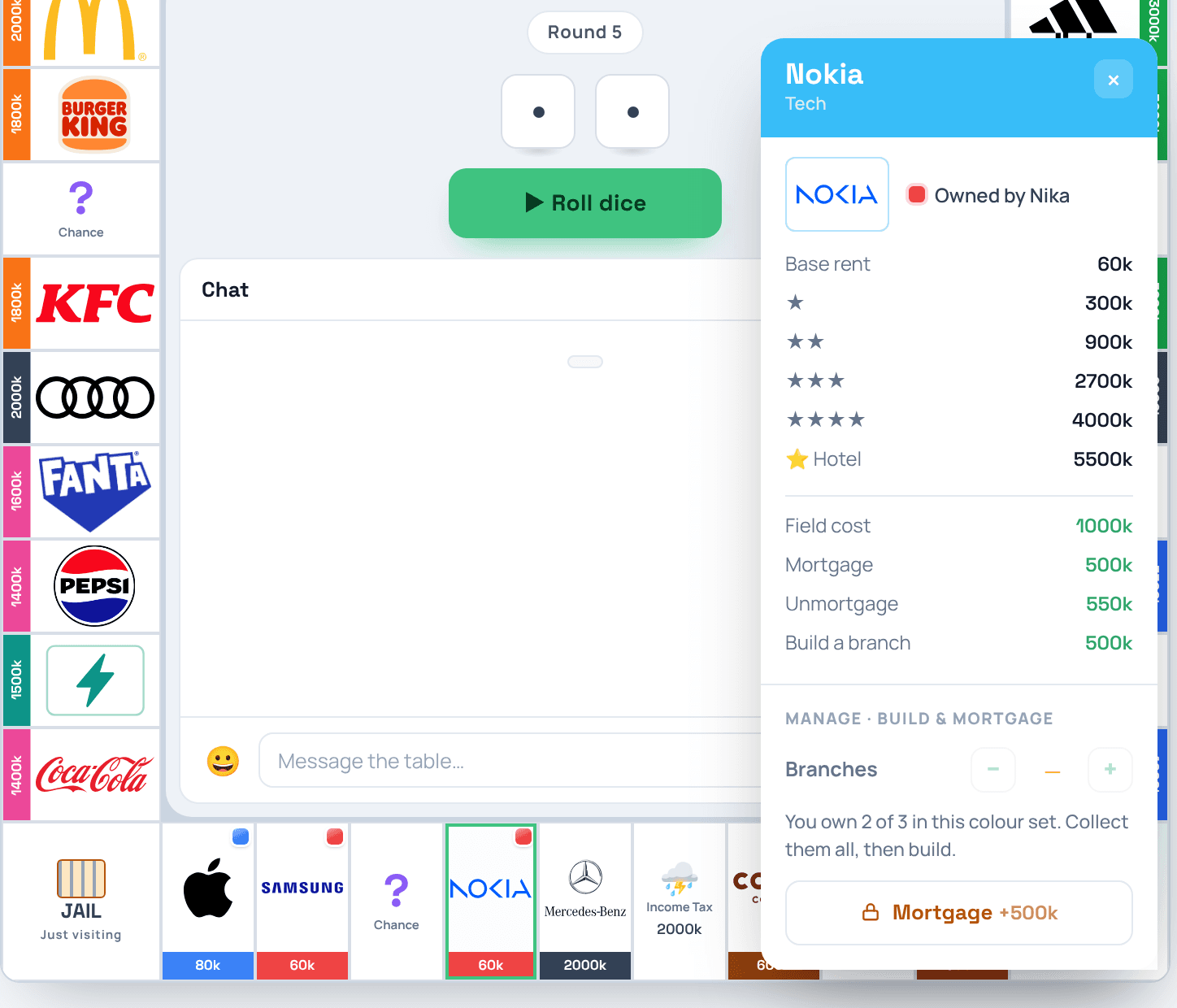
Now the + is on every street you own. When it cannot be pressed it says why, in one line, and the reasons are checked in a deliberate order — from the one that can never change to the one that clears by your next turn:
- Only streets can be built on — not cars, airlines or utilities.
- You own 2 of 3 in this colour set. Collect them all, then build.
- A field in this set is mortgaged — buy it back to unfreeze the set.
- This field is mortgaged. Buy it back to build on it.
- Fully built — a hotel is the top level.
- Build the set evenly — the fields with the fewest branches go first.
- One branch per field per turn. Come back next turn.
- Not enough cash — a branch here costs 500k.
- Build at the start of your turn, before you roll.
The padlock and the stars say what they mean
The small symbols got words, too. The stars on a street now read as a level — “Level 3 of 5”. The padlock on a mortgaged field says “Mortgaged — collects no rent” — and in Speed, where a mortgage has a deadline, it names the round: “Buy it back before round 28, or it goes back on sale.”
The rent tax, on both sides of the payment
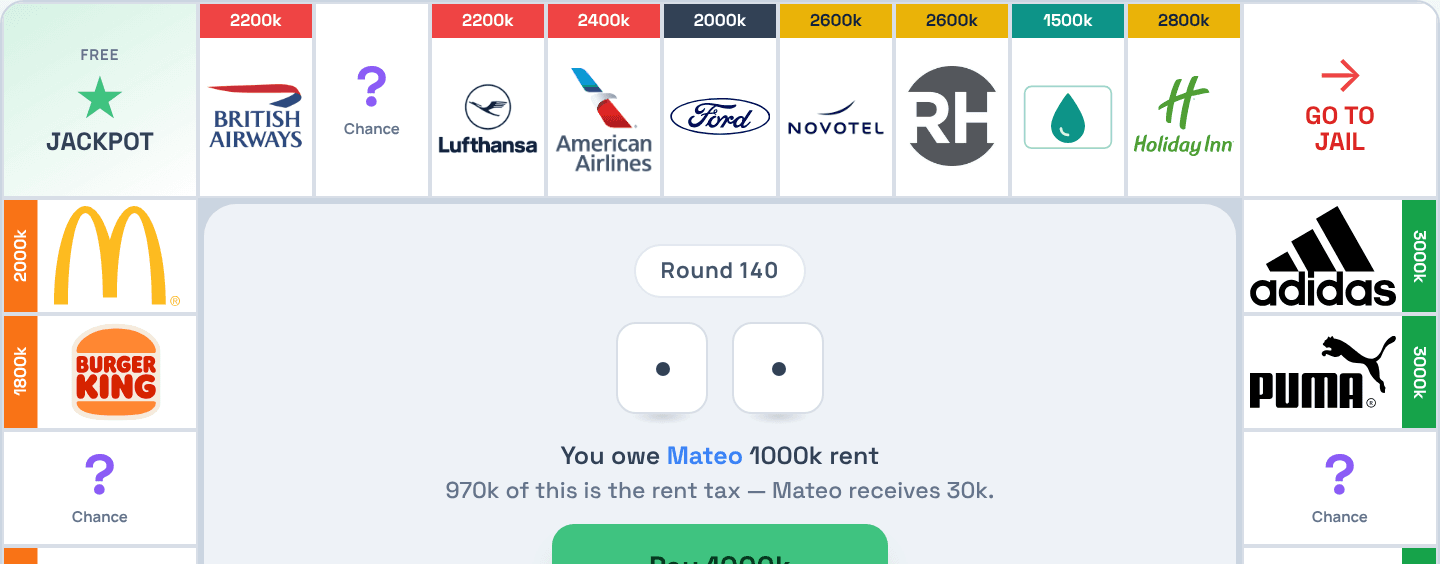
And the rent tax shows on both sides of a payment. Late in a long game, part of every rent is withheld so that the game can end; until now only the arithmetic knew. The player paying sees the split under the Pay button, and the owner gets a short card the first time it happens: who paid how much, how much arrived and how much was withheld. In the last two weeks 492 of 5,345 finished games ran long enough for it — and 221 of 583 games of Speed, where it starts at round 40.
Questions people ask
Why can’t I build on my street?
Tap the street’s name to open its card: the build button is there, greyed out, with the reason written under it — for example, that you own only 2 of the 3 streets in its colour set.
What does the padlock on a property mean?
The property is mortgaged and collects no rent until you buy it back. In Speed mode a mortgage also has a deadline, and the padlock names the round by which you must redeem it.
What is the rent tax?
Late in a long game, part of every rent is withheld so the game can end: the payer is charged the full rent and the owner receives what is left after the tax. It starts at round 100 in Classic by default and at round 40 in Speed, while a Blitz game ends at round 25, before it begins.
What do the stars on a street mean?
Each star is one branch built on it, and the label reads the total as a level — “Level 3 of 5”. The last level is a hotel.
For the technically curious
The order of the reasons is the design. The old check asked “is it your turn?” first, so a player without a colour set, between turns, was told it was not their turn — and learned a rule that does not exist. Now the reason you see is the one that will still be true after everything else is fixed: a car, an airline or a utility can never be built on; a street needs its whole set; only then come mortgages, the hotel limit, building evenly, one branch per turn, cash — and, last, the timing.
The rule used to be a single yes-or-no answer tucked inside the game screen, where no automated test could reach it. It now lives in its own small function that returns which of the nine reasons applies, and the checks that run on every change to opolyx test it directly — the order included, so putting “not your turn” first again would fail a test written for exactly that.
Refusals got the same treatment. When the game or the lobby says no — the room just filled up, the game has already started, you are already in another game — the answer used to be an English sentence, sometimes with an internal id in it. The database now answers with a short, stable token instead (38 refusals across 10 of its functions), and the site turns each token into a sentence in your language: all 12 of them, every refusal.
| Situation | Before | Now |
|---|---|---|
| A room fills up just as you join | game 1c92342f-… is full | That room just filled up. |
| You act when it is not your turn | Please refresh the page. It’s not your turn. | It’s not your turn. Reload the page to catch up. |