The game shows you the moves nobody finds
Most first-time players never build a house — the move that actually wins games. opolyx now points out the two moves you have to discover, at the moment they apply to your board.
In plain words
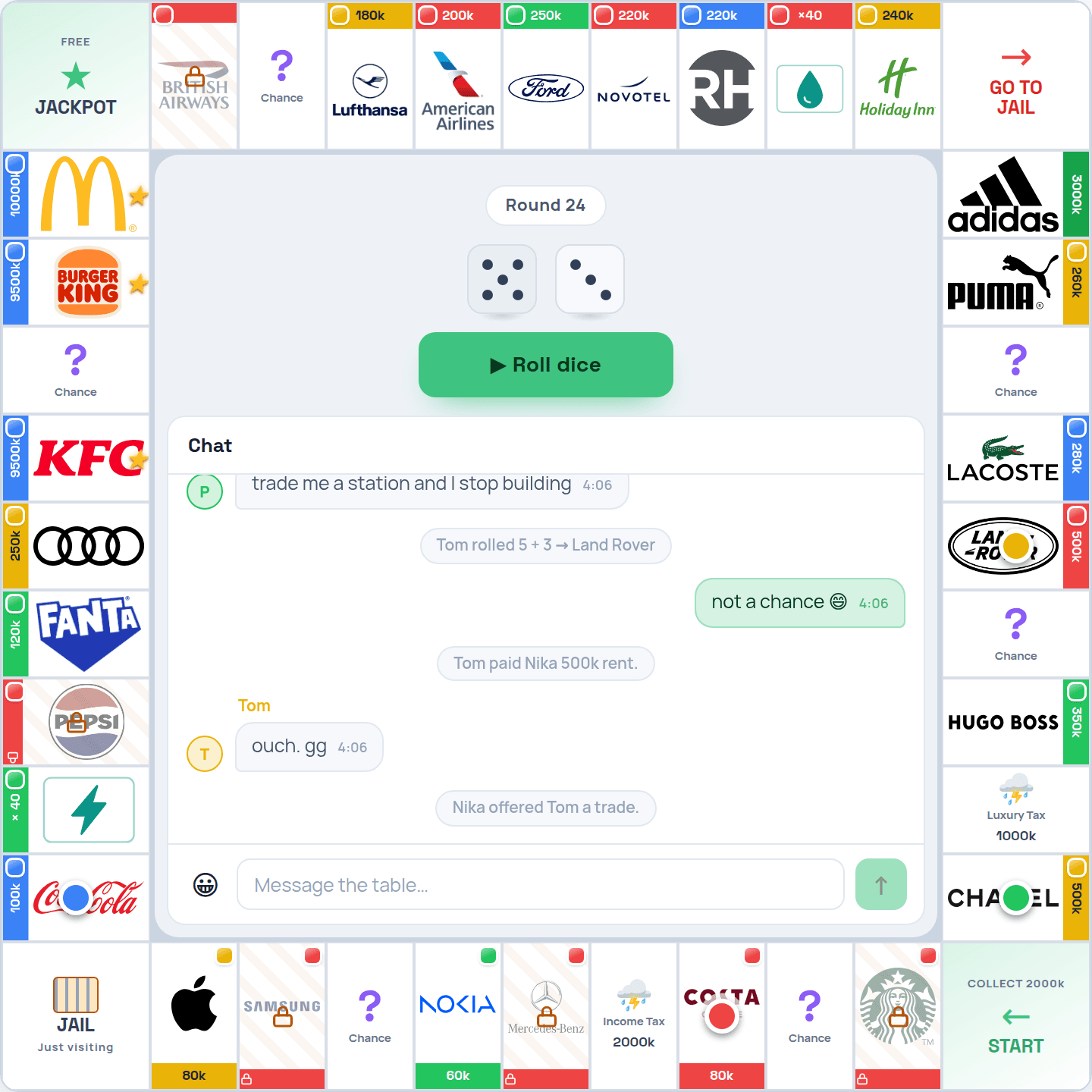
A Monopoly board does not explain itself. Buying is easy to find, because landing on something free puts the offer in front of you. Building and trading are not: nothing on the board ever suggests them, so you only do them if you already knew they were there. On production that shows up exactly as you would expect — buying barely changes between a player’s first game and their third, while building and trading roughly double. Which is a polite way of saying most people spend their first game not knowing how the game is won.
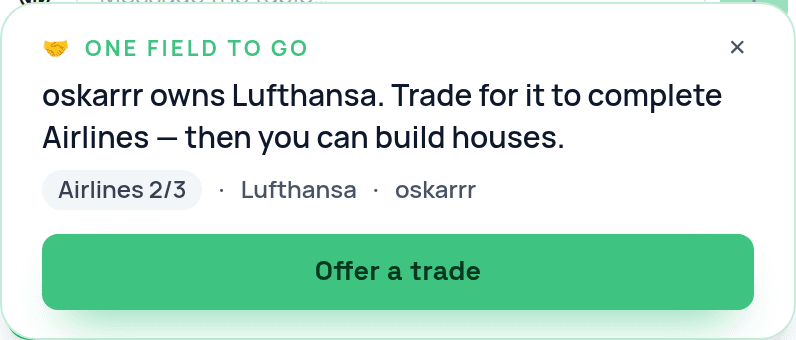
So the game now says something, three times, and only to players who have not yet finished a game. While you are waiting for a room to fill it explains the chain the whole game runs on — buy fields, complete a colour set, build on it, collect much more rent. When you are one field short of a set somebody else is holding, it tells you which field, who has it, and opens the trade already addressed to them. And when you complete a set, it offers to build.
None of it gets in your way. Nothing is modal, nothing pauses the game — everyone else is on a turn timer, so a card that has to be dismissed before you can play would be worse than saying nothing at all. Each card can be waved away and stays away, and every button does exactly what it says on it rather than opening a menu for you to find the thing yourself.
For the technically curious
The measurement that shaped all of this separates mechanics the game OFFERS you from mechanics you have to DISCOVER. Offered ones sit flat across a player’s first three games; discovered ones roughly double over the same span. That gap is not a skill curve — it is the moment somebody found out the feature existed, and it is the only part of a first game that a hint can move.
| Share of players who... | First game | Third game |
|---|---|---|
| bought a field | 66% | 74% |
| built a house | 21% | 46% |
| proposed a trade | 24% | 49% |
Three more obvious explanations were tested first and all three are false, which is why none of them were built. Winning your first game makes no difference to whether you come back — the return rate for winners and losers is the same to within half a point. A shorter game does not help either: the quickest mode returns slightly worse than the longest one. And having a real human opponent rather than bots is worth only a few points. What is left is comprehension, and comprehension is the one you can fix with words.
The cards sit at the foot of the board, and that took two attempts. The first version reused the lane the Chance notification uses, which looked free — and is only free because that notification cannot be clicked and disappears after four seconds. A card with buttons in the same place covers the roll control at every screen size, so a first-time player’s tap on Roll opened a trade form instead. Nothing caught it, because every test clicked the hint’s own button and none of them ever tried to roll. The regression test now hit-tests the roll control at four viewports rather than comparing rectangles, since a box check cannot tell a transparent wrapper from a card painted over the button.